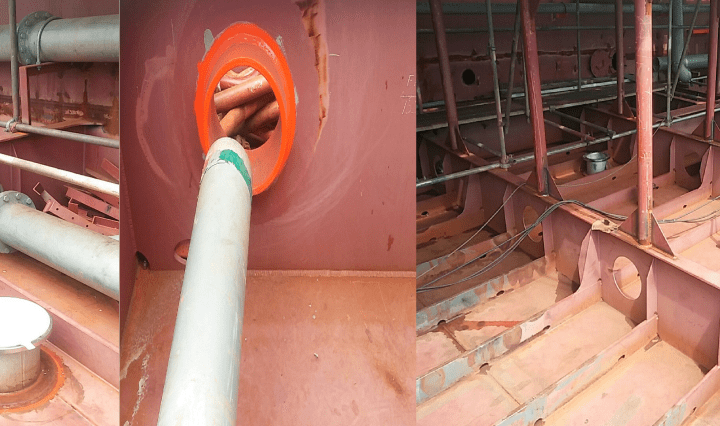
PSPC – Performance Standard for Coating of Ballast Tanks – Part 1

History briefs: In 2002, TSCF published “Guidelines for Ballast Tank Coating Systems and Surface Preparation” provided differing levels of standards for minimum target coating life of 10, 15 and 25 years (denoted as TSCF10, TSCF15, and TSCF25). In order to address the same issue for all vessels, in 2006 IMO adopted Resolution MSC 215(82) “ Performance Standard for Protective Coatings for Dedicated Seawater Ballast Tanks in all Types of Ships > 500GT and Double-Side Skin Spaces of Bulk Carriers >150m ” (commonly referred to as PSPC). This resolution came into force in 2008. PSPC is intended for a minimum target coating life of … Continue reading PSPC – Performance Standard for Coating of Ballast Tanks – Part 1

MARINE COROSSION AND PROTECTION (Part 1)

To understand how marine corrosion protection works, it’s necessary to look in more detail in to the corrosion process. In this undesired chemical effect, the material can reach with different chemicals in its surroundings. The reaction can be divided into: Chemical reaction Electro-chemical reaction These reaction take place exclusively at the surface  of material. It’s possible the microscopic pits are formed by corrosion on the metal’s surface.The corrosion can also occur in existing crack. CHEMICAL REACTION In chemical reaction, there’s a charge transfer between the reactions. If the exchange of charge is local effect, then the resulting ” Chemical corrosion … Continue reading MARINE COROSSION AND PROTECTION (Part 1)

HULL TANK STRUCTURE/AIR/HOSE TEST

GENERAL: “Test procedures are to confirm the water-tightness of tanks and watertight boundaries, the structural adequacy of tanks and the weather-tightness of structures/shipboard outfitting.” THERE’RE TWO TYPE OF TEST 1- Structure test  Structural Testing is a test to verify the structural adequacy of the construction of the tank (hydro static test) Structural testing may be carried out after the vessel is launched, some shipyard, they can be done in dry-dock. Visit: Shipbuilding Knowledge A-Z for more free topics on shipbuilding 2-Air leak test Leak Testing is a test to verify the tightness of the boundary (air testing, compressed air fillet weld testing, … Continue reading HULL TANK STRUCTURE/AIR/HOSE TEST

HULL FRAMING SYSTEM (TRANS/LONGI)

The selection of a structural framing system in any vessel must be made from a consideration of weight (TO BE MINIMIZED) , production matters (TO BE ACCESSIBLE FOR WELDING, NDT) , suitability to resist global loads and vibration. Vessels can principally be either transversely or longitudinally frame (DEPEND ON POSITION OF SHIP). There are three type of Hull framing system: Transverse Framing System Longitudinal Framing System Combined or Mixed Framing System (Hybrids framing system) Advantages: Resist Hydrostatic/local loading ( Bow & Engine room area, Cargo hold of Bulk carrier ) Absorb the vibration (E/R, Accommodation) Disadvantages: Heavier than Longitudinal framing system. Much deformation … Continue reading HULL FRAMING SYSTEM (TRANS/LONGI)

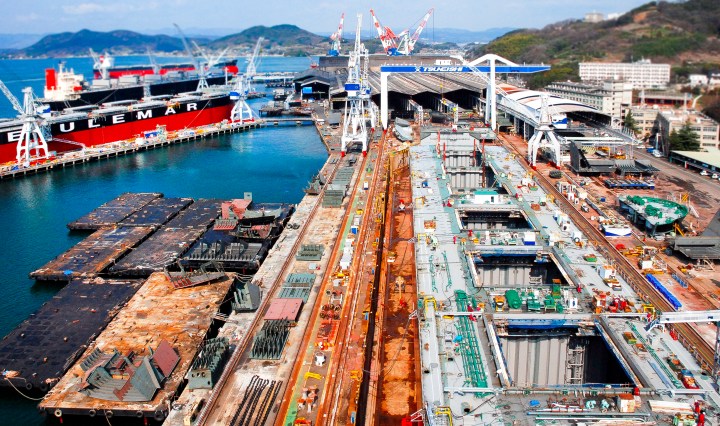
SHIP ICE CLASS

1-WHY DO SHIPS HAVE ICE CLASS? To permit the safe operation of ships in ice-covered sea areas   Visit: Shipbuilding Knowledge A-Z for more free topics on shipbuilding 2-WHO REQUIRE ICE CLASS QUALIFICATION? Coastal states with seasonal or year-round ice-covered oceans and seas Specific oceans and sea areas in the context of current and earlier commercial shipping developments for ice operation as well as applicable ice classes: BALTIC SEA: Bay and Gulf of Bothnia, Gulf of Finland – Finnish-Swedish Ice Class Rules (FSICR) Gulf of Finland (Russia territorial waters) – Russian Maritime Register (RMR) Ice Class Rules ARCTIC OCEAN: Barents, Kara, … Continue reading SHIP ICE CLASS