General about Marine Fuels!

Marine fossil fuels: The majority of the existing and proposed marine fuels are of the same origin. The same fuel composition may be available from renewable sources (e.g. natural gas – bio gas, methane…) but here only the most common are taken into consideration. + How is a crude oil feld formed? The generally accepted theory is that crude oil was formed over millions of years from the remains of plants and animals that lived in the seas. As they died, they sank to the seabed, were buried with sand and mud, and became an organic-rich layer. Steadily, these layers … Continue reading General about Marine Fuels!

Zinc in the Fuel oil (affection on Machinery explanation & experiment, gears, and prevention)

For marine work, we have tank and pipe to store & transfer oil. Now this topic will search about the effect of Zinc coating for tank and pipe in fuels oil. The concentration of zinc in a fuel was found depend upon … Continue reading Zinc in the Fuel oil (affection on Machinery explanation & experiment, gears, and prevention)

EEDI and CO2 emission

During the 62nd session of the MEPC (11–15 July 2011), at IMO Headquarters in London, the represented Parties to MARPOL Annex VI adopted amendments to Annex VI Regulations for the prevention of air pollution from ships. Considered the first regulation to establish CO2 standards across a global sector, the Energy Efficiency Design Index (EEDI). In terms of CO2 emissions, shipping contributes to about 2.5% of the world’s emissions and the emission rate will increase by 75% in the next 15 years due to demand and growth in global trade. What is EEDI mean? The EEDI is used to calculate a … Continue reading EEDI and CO2 emission

Engines with NOx and Tier I, II, III status

Air pollution from ships is on the rise and global emission standards are getting stringent every year. MARPOL Annex VI limits the main air pollutants contained in ships exhaust gas, including sulphur oxides (SOx) and nitrous oxides (NOx), and prohibits deliberate emissions of ozone depleting substances. What is NOx? NOx is a term for mono-nitrogen oxides NO and NO2 (nitric oxide and nitrogen dioxide). They are produced from the reaction of nitrogen and oxygen gases in the air during engine combustion, in other mean,  NOx formed when diesel fuel is burned with excess air-oxygen intake. Nitrogen is a natural element in the … Continue reading Engines with NOx and Tier I, II, III status

Pipe Flushing (Full procedure, standards NAS, Filter selection, magnetic filter config.)

There is two type of flushing as below which are enough for pipelines flushing. 1. Chemical flushing (pickling). 2. Oil flushing. CHEMICAL FLUSHING (PICKLING) The purpose of chemical flushing is to remove any dirts, debris, oil, grease, rust, scale, ect form the pipelines. During … Continue reading Pipe Flushing (Full procedure, standards NAS, Filter selection, magnetic filter config.)

CENTRIFUGAL PUMP (Advanced)

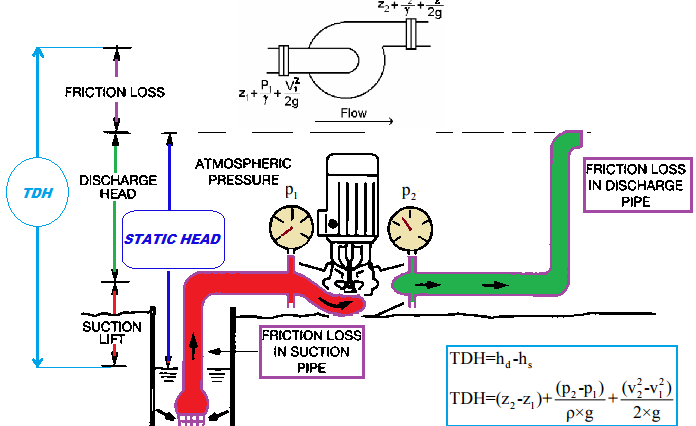
There’re some confusing fluid mechanic principles, you may understand it during learning individually. Meanwhile, it’s real difficult and daunting  to gather and compile all the theories to design a reasonable pump configuration as the demand. In this post, we’ll break down the anatomy of all concept through the centrifugal pump curve (Characteristic curves). The pump characteristic curve shows the performance of a pump. It usually shows TDH-Total dynamic Head, Power, Efficiency and NPSHr plotted over Flow rate at a given RPM. In these diagrams you can estimate pump behavior at constant speeds and a range of impeller diameters. Constant horsepower, … Continue reading CENTRIFUGAL PUMP (Advanced)

CENTRIFUGAL PUMP (Introduction)

Well for the inspectors, trainees, and freshers who just move into the piping systems will have their introduction, with fluid transporting devices which are mainly “PUMPS“. Almost piping system have the basic and the mostly optimized device know as centrifugal pump those are  handled easily and  it is cheaper when compared to other pumping devices, even maintenance cost is much lesser than the others. But the LIMITATION ( •cannot handle entrained air – 3%max •cannot handle viscous liquids) THERE’RE 5 MAIN PUMP STYLES: 1-Horizontal Split Case good wear resistance (Mean of higher price ) suction and inlet are opposite high head pressure ( Cooling … Continue reading CENTRIFUGAL PUMP (Introduction)