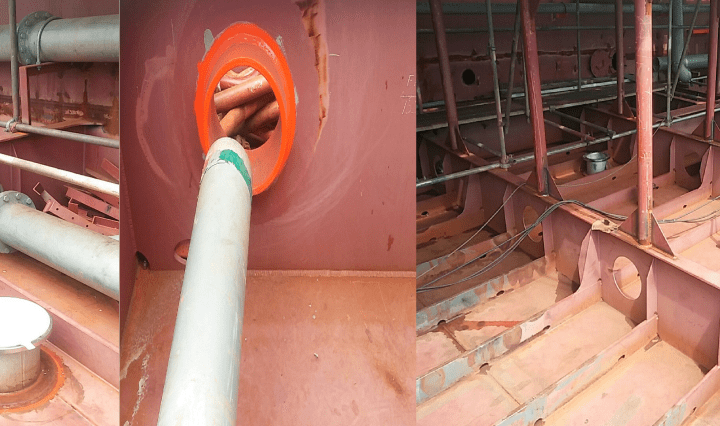
PSPC – Performance Standard for Coating of Ballast Tanks – Part 1

History briefs: In 2002, TSCF published “Guidelines for Ballast Tank Coating Systems and Surface Preparation” provided differing levels of standards for minimum target coating life of 10, 15 and 25 years (denoted as TSCF10, TSCF15, and TSCF25). In order to address the same issue for all vessels, in 2006 IMO adopted Resolution MSC 215(82) “ Performance Standard for Protective Coatings for Dedicated Seawater Ballast Tanks in all Types of Ships > 500GT and Double-Side Skin Spaces of Bulk Carriers >150m ” (commonly referred to as PSPC). This resolution came into force in 2008. PSPC is intended for a minimum target coating life of … Continue reading PSPC – Performance Standard for Coating of Ballast Tanks – Part 1

ODME – Oil discharge monitoring equipment

Oil tankers carry different types of oil cargo in their cargo tanks and it often happens that after discharging the oil cargo in some port, the ship sails without any cargo to some other destination. In order to do so, it has to take ballast from the sea to get better draught and stability. For this reason, ballast water is taken into cargo tanks wherein generally oil cargo would have been carried. It is to note that the ballast water carried in cargo tank has to be discharged out at sea before the next cargo loading. Therefore, Oil Discharge monitoring … Continue reading ODME – Oil discharge monitoring equipment

MGPS – Marine gross protection system

Marine growth in sea chests, box coolers and seawater piping systems is a potential threat for the performance and condition of your ship or installation. Blockages caused by barnacles (hầu)  and mussels (trai) are expensive and time consuming to remove and can have serious consequences. Engines will run at abnormally high temperatures, resulting in unnecessary increased fuel consumption and lower performance. To combat this risk the Marine Growth Prevention System (MGPS) was developed. Once installed it provides low maintenance and continuous protection against most hard and soft foulings as well as corrosion. The Marine Growth Prevention System utilizes an impressed … Continue reading MGPS – Marine gross protection system

MARINE COROSSION AND PROTECTION (Part 2)

Continuing on MARINE COROSSION AND PROTECTION (Part 1) that we discussed about the Electro-chemical corrosion protection methods and the last remained one is called ICCP system. Reversing the current by creating an opposite potential ( ICCP : Impressed current corrosion protection ) The ICCP system, a large positive current is applied to hull and pass through the adjacent water. As a result, current flow into ship’s steel whereas it has a direct unprotected contact with seawater and inducing a Cathodic reaction that protect the steel against the corrosion. To achieve this, the Rectifier (convert AC–>DC) is connected to ship’s steel with … Continue reading MARINE COROSSION AND PROTECTION (Part 2)

MARINE COROSSION AND PROTECTION (Part 1)

To understand how marine corrosion protection works, it’s necessary to look in more detail in to the corrosion process. In this undesired chemical effect, the material can reach with different chemicals in its surroundings. The reaction can be divided into: Chemical reaction Electro-chemical reaction These reaction take place exclusively at the surface  of material. It’s possible the microscopic pits are formed by corrosion on the metal’s surface.The corrosion can also occur in existing crack. CHEMICAL REACTION In chemical reaction, there’s a charge transfer between the reactions. If the exchange of charge is local effect, then the resulting ” Chemical corrosion … Continue reading MARINE COROSSION AND PROTECTION (Part 1)

MEGGER/RESISTANCE TEST

Megger test is the test that evaluate the insulation resistance quality. Insulation starts to age as soon as it’s made. As it ages, its insulating performance deteriorates. Any harsh installation environments, especially those with temperature extremes and/or chemical contamination, accelerates this process. This deterioration can result in dangerous conditions in power reliability and personnel safety. As such, it’s important to identify this deterioration quickly so that corrective steps can be taken. One of the simplest tests and its required test instrument are not universally understood. To help eliminate this lack of understanding, let’s discuss in detail Insulation Resistance (IR) testing … Continue reading MEGGER/RESISTANCE TEST

CENTRIFUGAL PUMP (Advanced)

There’re some confusing fluid mechanic principles, you may understand it during learning individually. Meanwhile, it’s real difficult and daunting  to gather and compile all the theories to design a reasonable pump configuration as the demand. In this post, we’ll break down the anatomy of all concept through the centrifugal pump curve (Characteristic curves). The pump characteristic curve shows the performance of a pump. It usually shows TDH-Total dynamic Head, Power, Efficiency and NPSHr plotted over Flow rate at a given RPM. In these diagrams you can estimate pump behavior at constant speeds and a range of impeller diameters. Constant horsepower, … Continue reading CENTRIFUGAL PUMP (Advanced)

SHIP TONNAGE AND HYBRID MEASUREMENT

Everyone who has looked at specifications for ships is often bewildered by the many different tonnages used for the same ship as DWT, GT, NT, LWT ect., Visit: Shipbuilding Knowledge A-Z for more free topics on shipbuilding An ocean ship may have different gross tonnage, depending on which country’s rules were used in determining the weight. Below is a good explanation on just what the tonnages for ships really are. TONNAGE (DWT, Displacement, Lightweight) Lightweight (LWT, LDT or LWDT) Basically the weight of the ship itself with no cargo, stores etc. Used widely at the time vessels are negotiating for scrap … Continue reading SHIP TONNAGE AND HYBRID MEASUREMENT