CSWIP 3.1 WELDABILITY

Key notes: General: Weldability depend on Carbon and alloy elements Poor weldability mean –> the occurrence of cracking Alloying elements: Carbon Most effect to the Hardness  Hardness is invert proportion Ductility    %C typical <~ 0.25-0.3% %CE or CVE ~ 0.4-0.5% Manganese De-sulfure –> reduce rick of Hot cracks (Solidification Crack) C-S (<0.8% Mn) vs C-Mn-S (<1.6% Mn) Molybdenum For Creep resistance  (at High temp operation)   HIC Higher susceptible in Alloy C-S (crack in weld) than C-S (crack in HAZ) Chevron (arrow) crack most occurred in SAW HIC never happen in Ni/Cu alloy (they can’t be harden by heat) … Continue reading CSWIP 3.1 WELDABILITY

CSWIP 3.1 DT & NDT

Key notes: General: Fillet weld fracture and Butt weld nick-break tests are not used for WPS (only for WPQR) CTOD impact test is used for Special concern in specification, not WPS   Hardness test: (Brinell-BHN/Vicker-HV/Rockwell-Rc) Hardest region Impact test: Izod vs Charpy Visual assessment  Tensile test: Proof stress Rp 0.2 – used for un-identified Y.S material (aluminium) Measuring the “overall strength of weld joint” –> TRANSVERSE T.S TEST   All weld metal T.S test –> For Electrode Manufacture only! STRA Test: Macro/Micro Examination: This is Quantity Test Bend Test: This test CAN evaluate the Fusion and Ductility T < 12mm … Continue reading CSWIP 3.1 DT & NDT

CSWIP 3.1 RESIDUAL STRESSES AND DISTORTION

Key notes: How many types (typical) ? Transverse Short-transverse (Non-uniform contraction through thickness) Longitudinal Thermal expansion is the greatest affecting factor (Alu, SS) “Yield strength – Y.S direct proportion with Residual Stress BUT Y.S is inverse proportion with Distortion (Because of elastic state/thermal expansion)“.  Neutral axis welding for distortion prevention Strong-backing method used for Thicker plate only. Back step/Skip welding method used for Thinner plate Continue reading CSWIP 3.1 RESIDUAL STRESSES AND DISTORTION

CSWIP 3.1 WELDING PROCESSES

Key notes: General: Typical H.I from 1 – 3.5 kJ/mm Plastic state welding or Non-fusion welding CC or CV Polarity and Penetration ability Operation Factor vs Duty Cycle  Affection of Torch Angle MMA: Typical OCV : 50-90V and Operation range : 20-40V Arc blow because of Magnetic force (DC) –> Prevent by using AC Run Out Length (ROL) –> For measuring the welding Speed TIG: Typical OCV : 50-90V and Operation range : 20-40V Filler rod – consumables vs Electrode – nonconsumable HF – high frequency  Arc starting can Damage the equipments AC used for Al and Mg (Because of Best Cleaning … Continue reading CSWIP 3.1 WELDING PROCESSES

CSWIP 3.1 WELDING CONSUMABLES

Key note: Storage Condition Dew point of Consumable Gas: – 60 Deg Filler material must be stored in an area with controlled temperature and humidity. MMA Consumables Core wire made by Rimming steel Weld properties controlled by covering Flux Silicon (De-oxidizer) added to Flux to avoid the Porosity inhibited by rimming steel Flux types comparison: Flux types identification: Impact test energy as per EN ISO 2560: Tensile strength or Yield Strength SS – ELECTRODE SMALLER THAN CS ELECTRODE BECAUSE OF LOWER ELECTRIC CONDUCTIVITY. TIG Consumables EB INSERT (SEE TERMS AND DEFINITIONS) Nitrogen will not be used for Ni,Ni-alloys and Mild … Continue reading CSWIP 3.1 WELDING CONSUMABLES

CSWIP 3.1 WELDING SYMBOLS

Key notes: Identification – – – – – – -(ISO)- – – – – – – / Reference lines Identification line (ISO) can be omitted in asymmetric joint Staggering symbol AWS vs ISO Peripheral (ISO) or Well all around (AWS) Partial penetration weld, “S” “z”– Leg size or “a” – Throat thickness Process identification between AWS and ISO Continue reading CSWIP 3.1 WELDING SYMBOLS

CSWIP 3.1 TERMS & DEFINITION

Key notes: TERMS: Brazing (A) vs Braze welding (B) Weld Zone JOINT TYPE: Autogenous welding Spot weld Lap joint (Electric resistance welding) WELDING PREPARATION: EB insert (Backing ring) vs Backing strips General Root Gap Asymmetric preparation WELDING TYPE: Compound weld and Special Groove (Bevel) weld in T-joint WELDING POSITIONS: Test Position vs Qualifying Position   Continue reading CSWIP 3.1 TERMS & DEFINITION

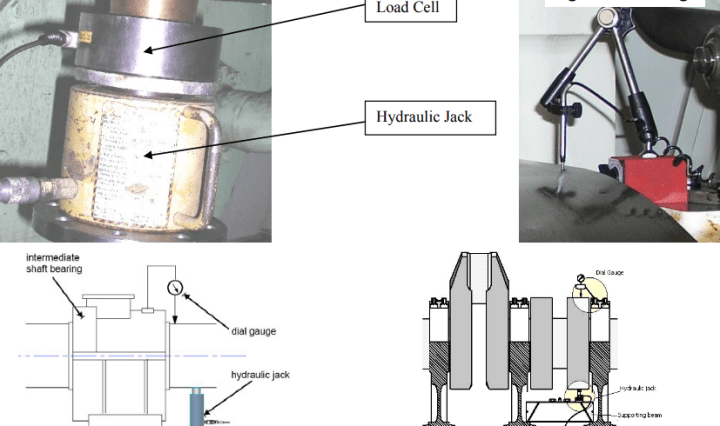
Main Engine Shaft Alignment – Comprehension (Check conditions/ items/ tolerance/ docking/ undocking/ bearing loads or reactions/ jackup curve understanding)

What is shaft alignment condition? “A static condition observed at the bearings supporting the propulsion shafts.” The basic procedure for determining vertical alignment of shafting and gears is to calculate, for the cold condition at time of aligning, a shape … Continue reading Main Engine Shaft Alignment – Comprehension (Check conditions/ items/ tolerance/ docking/ undocking/ bearing loads or reactions/ jackup curve understanding)