CENTRIFUGAL PUMP (Advanced)

There’re some confusing fluid mechanic principles, you may understand it during learning individually. Meanwhile, it’s real difficult and daunting  to gather and compile all the theories to design a reasonable pump configuration as the demand. In this post, we’ll break down the anatomy of all concept through the centrifugal pump curve (Characteristic curves). The pump characteristic curve shows the performance of a pump. It usually shows TDH-Total dynamic Head, Power, Efficiency and NPSHr plotted over Flow rate at a given RPM. In these diagrams you can estimate pump behavior at constant speeds and a range of impeller diameters. Constant horsepower, … Continue reading CENTRIFUGAL PUMP (Advanced)

CENTRIFUGAL PUMP (Introduction)

Well for the inspectors, trainees, and freshers who just move into the piping systems will have their introduction, with fluid transporting devices which are mainly “PUMPS“. Almost piping system have the basic and the mostly optimized device know as centrifugal pump those are  handled easily and  it is cheaper when compared to other pumping devices, even maintenance cost is much lesser than the others. But the LIMITATION ( •cannot handle entrained air – 3%max •cannot handle viscous liquids) THERE’RE 5 MAIN PUMP STYLES: 1-Horizontal Split Case good wear resistance (Mean of higher price ) suction and inlet are opposite high head pressure ( Cooling … Continue reading CENTRIFUGAL PUMP (Introduction)

SHIP TONNAGE AND HYBRID MEASUREMENT

Everyone who has looked at specifications for ships is often bewildered by the many different tonnages used for the same ship as DWT, GT, NT, LWT ect., Visit: Shipbuilding Knowledge A-Z for more free topics on shipbuilding An ocean ship may have different gross tonnage, depending on which country’s rules were used in determining the weight. Below is a good explanation on just what the tonnages for ships really are. TONNAGE (DWT, Displacement, Lightweight) Lightweight (LWT, LDT or LWDT) Basically the weight of the ship itself with no cargo, stores etc. Used widely at the time vessels are negotiating for scrap … Continue reading SHIP TONNAGE AND HYBRID MEASUREMENT

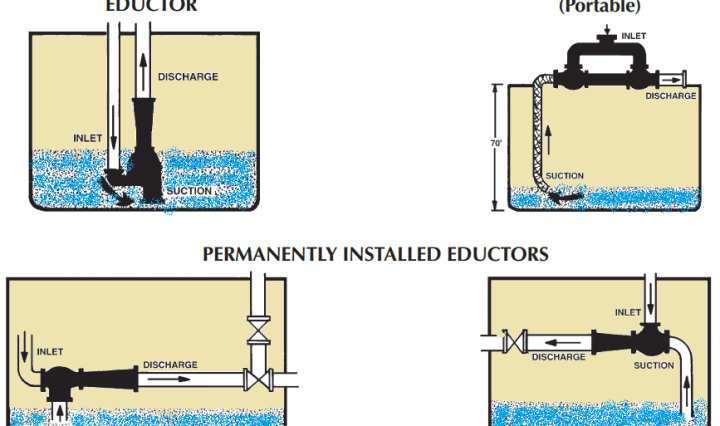
EDUCTOR AND EJECTOR – in shipbuilding, industrial (How to distinguish, calculation, selection, and purchasing)

  At the beginning, there’s no need to fret over the differences that the different is in the motive fluid: An ejector uses a gas phase motive, usually steam or air.  An eductor uses a liquid phase motive, usually water.  Eductors/Ejectors … Continue reading EDUCTOR AND EJECTOR – in shipbuilding, industrial (How to distinguish, calculation, selection, and purchasing)

X-BOW/STERN: Beyond the Conventional

One such change which made a splash in the maritime industry was the introduction of X-bow by the Norwegian Ulstein Group. Since the inception of their first ship M/V Bourbon Orca in 2005 several other ship building yards/companies have used their design. The X-bow comprises of a backward sloping bow starting at the extreme front of the vessel. This results in a continuous and smooth bow shape as shown below. Designing such a vessel involves proper weight distribution in the forward region which allows for submission and sharper bow shape. Increased volume up front WITH SLOWLY INCREASE BUOYANCY  FORCE allows … Continue reading X-BOW/STERN: Beyond the Conventional

HULL TANK STRUCTURE/AIR/HOSE TEST

GENERAL: “Test procedures are to confirm the water-tightness of tanks and watertight boundaries, the structural adequacy of tanks and the weather-tightness of structures/shipboard outfitting.” THERE’RE TWO TYPE OF TEST 1- Structure test  Structural Testing is a test to verify the structural adequacy of the construction of the tank (hydro static test) Structural testing may be carried out after the vessel is launched, some shipyard, they can be done in dry-dock. Visit: Shipbuilding Knowledge A-Z for more free topics on shipbuilding 2-Air leak test Leak Testing is a test to verify the tightness of the boundary (air testing, compressed air fillet weld testing, … Continue reading HULL TANK STRUCTURE/AIR/HOSE TEST

PIPING HYDRO-STATIC TEST COMPREHENSION

Two types “Shop test and After installation test” First, the hydro-static test of spool at Workshop is prefer to check the quality or strength of Welding joints, integral fittings and confirm whether it can satisfy the rule/standards requirement. TEST PRESSURE (Tp)= 1.5 DESIGN PRESSURE (Dp) “But we can not do final all spools at workshop and just bring on-board for assembly because there’re many Field Joints waiting you ahead. Depend on the flexibility of Rule/Spec, the low pressure pipe’s  field joints can be tested under max.working pressure” Second, in ideal condition, no more welding joints on-board, the Leak test will be … Continue reading PIPING HYDRO-STATIC TEST COMPREHENSION