

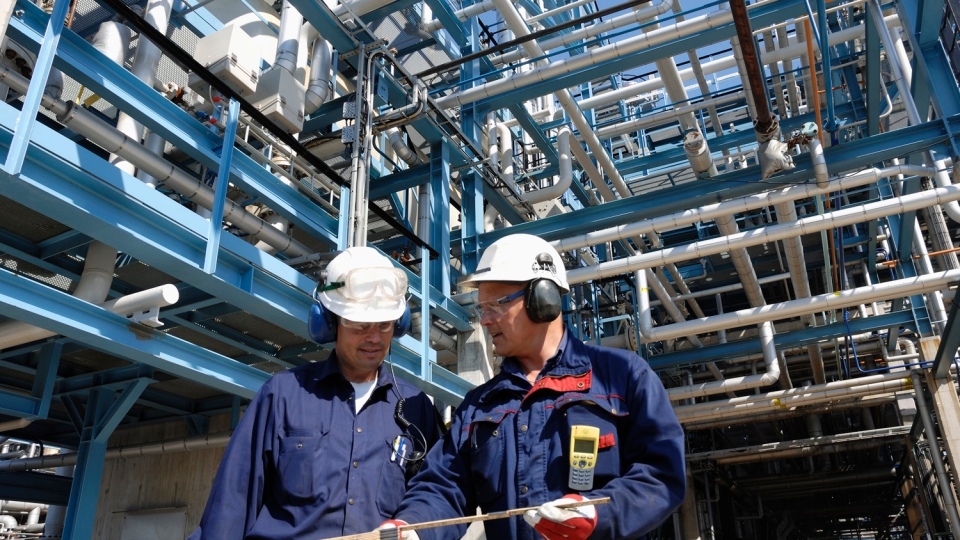
NDT NDE ASNT Questions and answers for PT, LPI level II (3).
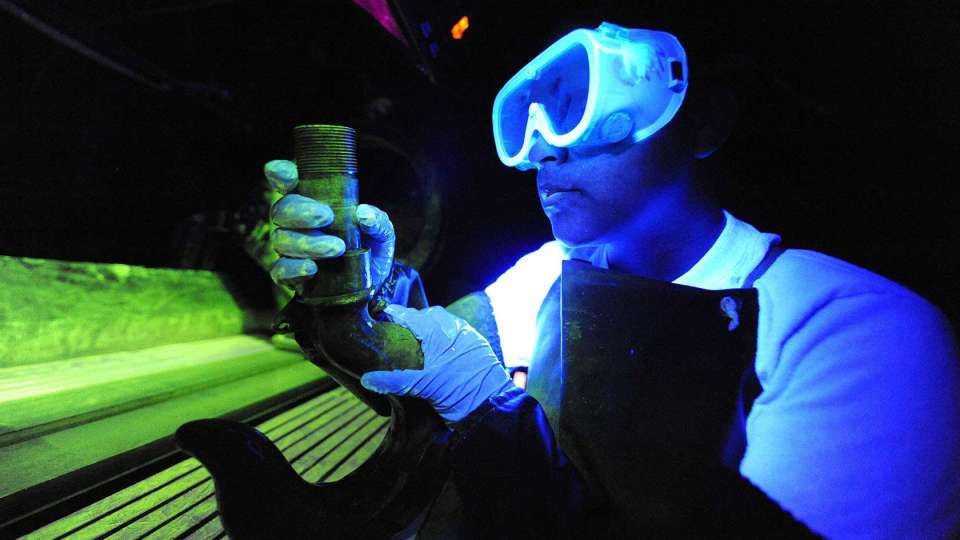
9. The height of capillary rise of the liquid or the depth to which penetrant enters, is more in the case of a. Wide and shallow discontinuities b. Narrow and deep discontinuities (answer) c. More information is required d. Determined by contact angle and surface tension 10. A liquid in a capillary tube has a concave surface a. The liquid has high surface tension (answer) b. Low surface tension c. More information is required d. The liquid is a Penetrant 11. Which of the following is true of flash point consideration in liquid Penetrant inspection? a. Flash point affects the … Continue reading NDT NDE ASNT Questions and answers for PT, LPI level II (3).
ASNT Questions and answers for PT, LPI level II (1).
1. Which of the items listed below is NOT an advantage of the liquid penetrant test method? A. The method can find all types of discontinuities (answer) B. The method is simple in principle and relatively easy to understand. C. The method is essentially simple in application. D. There are few limitations on the size and shape of the article that can be treated by this method. 2. When using post-emulsification penetrants, difficulties incurred during the washing operation can be overcome by: A. Reapplying a coat of emulsifier B. Increasing the water pressure used during the washing operation C. Completely … Continue reading ASNT Questions and answers for PT, LPI level II (1).
ASNT Questions and answers for PT, LPI level II (2).
1- Which of the following should be removed in order to obtain a good penetrant test? a. Varnish b. Oxides c. Plating d. All of the above (answer) 2 – Which method is used to primarily to inspect small localized areas? a. Method A b. Method B c. Method C (answer) d. Method D 3 – Large defects can be hidden under a painted surface because: a. The paint will fill in the cracks and change the fluorescence of the penetrant b. Paint is more elastic than metal and will not fracture (answer) c. The penetrant will adhere to the … Continue reading ASNT Questions and answers for PT, LPI level II (2).
NDE Magnetic Testing (MPI) Standard and Criteria
The ASME V is the guideline to make an NDE procedure, how to evaluate the report or defect is defined by Construction as below for your quick reference: 1. ANSI/ASME B31.1 Power Piping The following relevant indications are unacceptable: 1.1. Any cracks or linear indications. 1.2. Rounded indications with dimensions greater than 3/16 inch (4.8mm). 1.3. Four or more rounded indications in a line separated by 1/16 inch(1.6 mm) or less edge to edge. 1.4. Ten or more rounded indications in any 6 square inches (3,870 mm²) of surface with the major dimension of this area not to exceed 6 inches (150 mm) with the area taken in the most … Continue reading NDE Magnetic Testing (MPI) Standard and Criteria
NDE Penetrant testing (PT) Standards and Criteria
The ASME V is the guideline to make an NDE procedure, how to evaluate the report or defect is defined by Construction as below for your quick reference: ANSI / ASME B31.1 &ANSI / ASME B31.3 Indication > 1/16″(1.5mm) shall be considered as relevant 1. Linear Indication: Any crack or linear indication 2. Rounded Indications Indications with dimensions >3/16″(5.0mm) Four or more rounded indication in a line separated by 1/16″(1.5mm) or less edge to edge. 3. Ten or more rounded indication in any 6 in of surface with the major dimension of this area not to exceed 6 in. ASME … Continue reading NDE Penetrant testing (PT) Standards and Criteria
Magnetic particle inspection standards ASTM E709, ASTM E1444 and ASTM E3024
Magnetic particle users outside the aerospace industry have typically used ASTM E709 Standard Guide for Magnetic Particle Testing as their baseline standard for procedures. ASME, AWS, and API standards all use ASTM E709 as a reference to build their specific requirements. However, from an ASTM perspective, E709 is officially a “Guide,” which ASTM defines as, “a compendium of information or series of options that does not recommend a specific course of action. A guide increases the awareness of information and approaches in a given subject area.” This means it provides information and recommendations, but it does not actually include any hard requirements. … Continue reading Magnetic particle inspection standards ASTM E709, ASTM E1444 and ASTM E3024

Wordads CPM 2020
It is crazy low … as below: The average for 1000 ads-served is only $0.05. If one day, your site gets 1000 views. It means 1000×10 (10 ads tabs) = 10000 ads-served ~ 0.5$. Following that, if you get 10,000 views a day, you will get ~ 5$ (it’s too low comparing with our work). Let see the location of viewers in my site: It’s over the world … every country is recorded … why CPM is too low ???… Many affection factors (Timing of view, IP location, Cookies allowed, budget of ads, etc.,), and it is too difficult to … Continue reading Wordads CPM 2020

PWHT weld stress relieve concept
Stress-relieving is a form of post-weld heat treatment. In stress-relieving we heat a material to a specific temperature; hold it at this temperature for a specified amount of time in order to reduce or eliminate residual stresses, and then cool it at a slow enough rate to prevent these stresses from redeveloping. In most cases, stress relieving is done to regain dimensional tolerance and to reduce distortion. Distortion occurs due to the rapid and uneven heating and cooling of the weld metal and the surrounding base metal. As the molten weld metal cools it contracts and does so at a … Continue reading PWHT weld stress relieve concept

Weld Hot Crack vs Cold Crack
We recently helped out a customer in determining why some of their welds were cracking. It was determined that cracking on their parts was due to rapid cooling and improperly sized welds. The discussions we had before and after determining the cause were quite interesting. We went over the typical causes of cracking with our customers. Here is a brief summary of our meetings. Please note that these are not all the causes for cracks. Generally speaking, we can separate cracks in two groups, which have to do with the timing of the cracks: hot cracking and cold cracking. Essentially … Continue reading Weld Hot Crack vs Cold Crack
 AMARINE