
NDE Penetrant testing (PT) Standards and Criteria
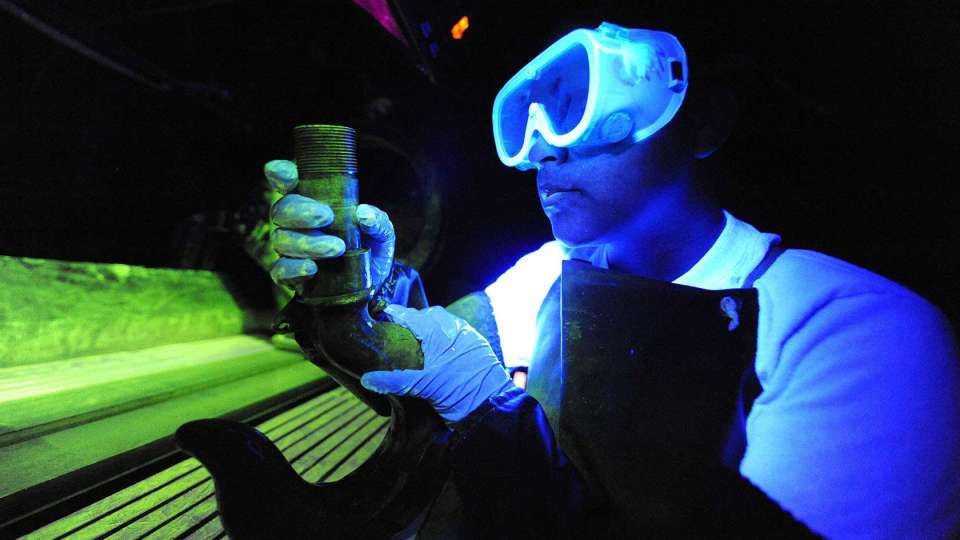
The ASME V is the guideline to make an NDE procedure, how to evaluate the report or defect is defined by Construction as below for your quick reference: ANSI / ASME B31.1 &ANSI / ASME B31.3 Indication > 1/16″(1.5mm) shall be considered as relevant 1. Linear Indication: Any crack or linear indication 2. Rounded Indications Indications with dimensions >3/16″(5.0mm) Four or more rounded indication in a line separated by 1/16″(1.5mm) or less edge to edge. 3. Ten or more rounded indication in any 6 in of surface with the major dimension of this area not to exceed 6 in. ASME … Continue reading NDE Penetrant testing (PT) Standards and Criteria
Magnetic particle inspection standards ASTM E709, ASTM E1444 and ASTM E3024
Magnetic particle users outside the aerospace industry have typically used ASTM E709 Standard Guide for Magnetic Particle Testing as their baseline standard for procedures. ASME, AWS, and API standards all use ASTM E709 as a reference to build their specific requirements. However, from an ASTM perspective, E709 is officially a “Guide,” which ASTM defines as, “a compendium of information or series of options that does not recommend a specific course of action. A guide increases the awareness of information and approaches in a given subject area.” This means it provides information and recommendations, but it does not actually include any hard requirements. … Continue reading Magnetic particle inspection standards ASTM E709, ASTM E1444 and ASTM E3024

Wordads CPM 2020
It is crazy low … as below: The average for 1000 ads-served is only $0.05. If one day, your site gets 1000 views. It means 1000×10 (10 ads tabs) = 10000 ads-served ~ 0.5$. Following that, if you get 10,000 views a day, you will get ~ 5$ (it’s too low comparing with our work). Let see the location of viewers in my site: It’s over the world … every country is recorded … why CPM is too low ???… Many affection factors (Timing of view, IP location, Cookies allowed, budget of ads, etc.,), and it is too difficult to … Continue reading Wordads CPM 2020

PWHT weld stress relieve concept
Stress-relieving is a form of post-weld heat treatment. In stress-relieving we heat a material to a specific temperature; hold it at this temperature for a specified amount of time in order to reduce or eliminate residual stresses, and then cool it at a slow enough rate to prevent these stresses from redeveloping. In most cases, stress relieving is done to regain dimensional tolerance and to reduce distortion. Distortion occurs due to the rapid and uneven heating and cooling of the weld metal and the surrounding base metal. As the molten weld metal cools it contracts and does so at a … Continue reading PWHT weld stress relieve concept

Weld Hot Crack vs Cold Crack
We recently helped out a customer in determining why some of their welds were cracking. It was determined that cracking on their parts was due to rapid cooling and improperly sized welds. The discussions we had before and after determining the cause were quite interesting. We went over the typical causes of cracking with our customers. Here is a brief summary of our meetings. Please note that these are not all the causes for cracks. Generally speaking, we can separate cracks in two groups, which have to do with the timing of the cracks: hot cracking and cold cracking. Essentially … Continue reading Weld Hot Crack vs Cold Crack
Weld Crack causes and remedies
Cracks on welds are never good. Welding codes always have allowances for porosity, undercut, weld sizes, and even weld profiles. However, there is never an allowance for cracks. Being a linear discontinuity, a crack will tend to propagate through the weld and into the base metal with relative ease, especially in cyclically loaded structures. So naturally we want to avoid cracks at all costs. Below is a list of 6 mistakes you need to avoid in order to reduce cracking susceptibility. 1- Using a matching filler metal – there is a misconception that because codes list matching filler metals (to base … Continue reading Weld Crack causes and remedies

Stainless steel welding and sensitiztion
Stainless steels are iron-based alloys that contain a minimum of 10.5% chromium. This chromium reacts with the air and forms a very thin but very tenacious chromium oxide layer which is what prevents stainless from rusting. There are 5 types of stainless steels that are categorized depending on additional alloying elements. One thing they all have in common is the minimum chromium content of 10.5%. The five types are: Austenitic Stainless Steels Ferritic Stainless Steels Martensitic Stainless Steels Duplex Stainless Steels Precipitation Hardening Stainless Steels Out of these five, austenitic stainless are the most common and familiar types of stainless steels. They exhibit … Continue reading Stainless steel welding and sensitiztion

Hydrogen Induced Cracking (HIC) in welding
Hydrogen Induced Cracking (HIC), also called hydrogen assisted cracking (HAC) and cold cracking, is a common welding defect when welding heavy steel sections and steels with high carbon content. In the above mentioned article we explained that you need three things in order to have cold cracking: source of hydrogen, susceptible microstructure and a certain level of stress. If you can eliminate one you eliminate the potential for cold cracking. When we ignore this, whether by choice or by ignorance, we are in trouble. However, many weldments fail due to hydrogen induced cracking even when good welding procedures are in … Continue reading Hydrogen Induced Cracking (HIC) in welding

CWI welding inspector notes
Today we’ll cover 5 more very important concepts that are governed by the AWS D1.1 Structural Welding Code (Steel). These concepts can show up as questions in the Certified Welding Inspector (CWI) Exam. As stated in our article from last week, in this exam you don’t have to explain your answers, you simply have to choose the right answer (multiple choice exam). As long as you can find the answer in the codebook you are good. However, it is very important to know why the code imposes certain limits and requirements. Below are 5 more fundamental principles that must be … Continue reading CWI welding inspector notes
 AMARINE