





Centrifugal Pump Structure
There are a few components that virtually every centrifugal pump has in common. These components include: An impeller A volute or diffuser style casing A shaft Shaft sleeves Bearings A sealing arrangement These parts can be subdivided into the wet end and … Continue reading Centrifugal Pump Structure

Centrifugal Pump Casings
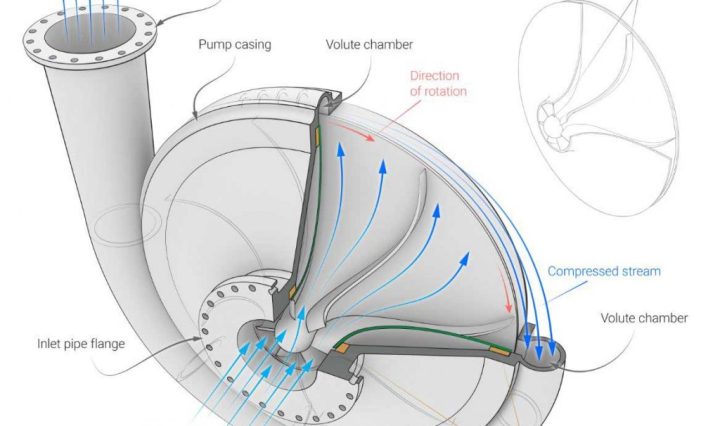
The centrifugal pump casing is the component of the pump that converts all of the velocity created by the rotating impeller into a controlled and stable flow and directs it out of the pump through the discharge point. The most common type of casing is called a volute and it looks similar to a snail shell. Image from A Brief Introduction to Centrifugal Pumps by Joe Evans, Ph.D The impeller is placed within the volute. However, as you may have noticed in the image above, the impeller is not typically centered in the volute. Instead, the impeller is positioned so … Continue reading Centrifugal Pump Casings

Centrifugal Pump Impellers
The impeller of a centrifugal pump is rotated rapidly to impart velocity to a pumped liquid. If you’ve never seen a pump impeller before, visualize a boat propeller. When a boat propeller is rotated it imparts velocity to the liquid around it. As the liquid moves, that velocity forces the propeller to move forward in the water. Now imagine what would happen if the boat were anchored in place, firmly enough to prevent the boat from moving. Next imagine that the velocity generated by the boat propeller were contained and controlled so that a stream of water was created that … Continue reading Centrifugal Pump Impellers

Pump Components: Volutes, Casings, and Impellers
When you boil them down to the most fundamental components, pumps are made up of two components: An impeller which creates velocity through rotation, And a casing which converts velocity into pressure. There are different types of impellers and different types of casings. The way that different types of impellers and casings are combined produces all of the different types of pumps. Types of Pump Casings There two basic types of pump casings: volutes and diffusers. Whether we’re talking about volutes or diffusers, what all casings have in common is that they are designed to take energy in the form of … Continue reading Pump Components: Volutes, Casings, and Impellers

Centrifugal Pump
A centrifugal pump is a machine that uses rotation to impart velocity to a liquid and then converts that velocity into flow. Let’s break that definition down into its components so that we can consider each one in turn: A centrifugal pump is a machine. A centrifugal pump uses rotation to impart velocity to a liquid. A centrifugal pump converts velocity into flow. “A centrifugal pump is a machine.” Every centrifugal pump includes an assembly of mechanical components that make operation of the pump possible. This mechanical assembly includes the pump shaft mounted on bearings, the sealing mechanism that keeps the pump from … Continue reading Centrifugal Pump

Design draft vs Scantling draft ( full words )
The Draft, as simple definition is the distance between the sea level and the bottom of hull (included the thickness of bottom – see this topic) Meanwhile, at the initial design stage, there are two terms of Scantling & Design … Continue reading Design draft vs Scantling draft ( full words )

Protected: Ship IMO type I, II, III (full words)
There is no excerpt because this is a protected post. Continue reading Protected: Ship IMO type I, II, III (full words)

What is CJP in welding
According to AWS D1.1 requirement (The others like ASME IX, EN ISO 15614. API 1104 doesn’t) CJP (complete joint penetration): A joint root condition in a groove weld in which weld metal extends through the joint thickness. There are two … Continue reading What is CJP in welding

Back gouging in welding
When welding on thick plate or pipe, it is often impossible for the welder to get 100% penetration without some type of groove being used. The groove may be cut into just one of the plates or pipes or both. On some plates it can be cut both inside and outside of the joint. The groove may be ground, flame cut, gouged, sawed, or machined on the edge of the plate before or after the assembly. Bevels and V-grooves are best if they are cut before the parts are assembled. J-grooves and U-grooves can be cut either before or after assembly. … Continue reading Back gouging in welding
 AMARINE