



Welding Power Types CC, CV, RAV
Welding power can be supplied as three typical types as below: ■ Constant voltage (CV)—The arc voltage remains constant at the selected setting even if the arc length and amperage increase or decrease. ■ Rising arc voltage (RAV)—The arc voltage increases as the amperage increases. ■ Constant current (CC)—The total welding current (watts) remains the same. This type of power is also called drooping arc voltage (DAV) because the arc voltage decreases as the amperage increases. The shielded metal arc welding (SMAW) process requires a constant current (CC) arc voltage characteristic, illustrated by the constant current line. The shielded metal arc … Continue reading Welding Power Types CC, CV, RAV

Welding Current Types DCEN, DCEP, AC
There are three different types of current used for welding are alternating current (AC), direct-current electrode negative (DCEN), and direct current electrode positive (DCEP). The terms DCEN and DCEP have replaced the former terms direct-current straight polarity (DCSP) and direct-current reverse polarity (DCRP). In other words, DCEN and DCSP are the same currents, and DCEP and DCRP are the same currents. Some electrodes can be used with only one type of current. Others can be used with two or more types of current. Each welding current has a different effect on the weld. DCEN – Use for GTAW, SMAW- Root or … Continue reading Welding Current Types DCEN, DCEP, AC
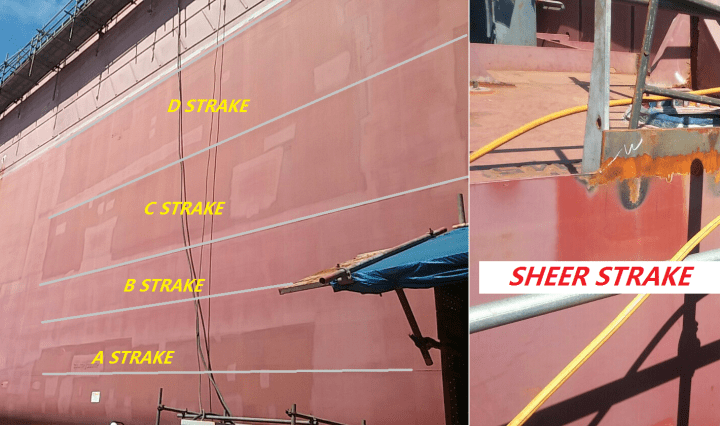
Shear Strake Plate of Ship (full words)
This topic is an additional knowledge support for SHIP STRENGTH CALCULATION (Part 1) and SHIP STRENGTH CALCULATION (Part 2). Under sea-going condition, the Hogging and Sagging condition make the ship steel be continuously compressed and stretched those making steel become fatigue collapsed specially … Continue reading Shear Strake Plate of Ship (full words)
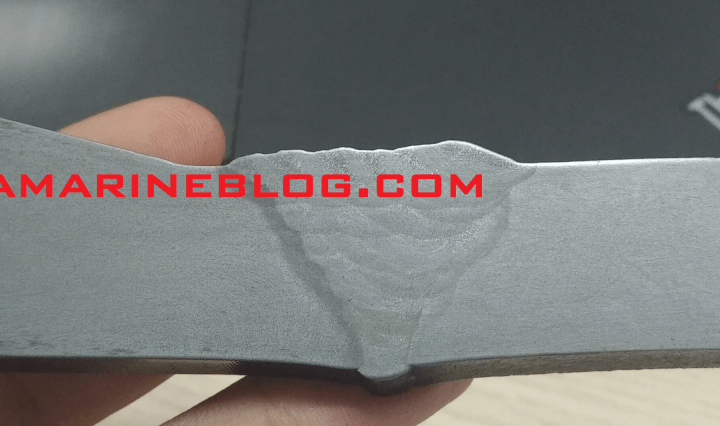
Protected: Preheating for Transition joint ( Different thickness ) – full words
There is no excerpt because this is a protected post. Continue reading Protected: Preheating for Transition joint ( Different thickness ) – full words

How welding Arc heat, Temperature be produced?
The term temperature refers to the degree or level of energy in a material and can be measured in degrees with a thermometer. The term heat refers to the quantity of energy in a material and cannot be easily measured. The quantity of heat in a material can be determined by knowing both the temperature and mass (weight) of an object. Likewise, the temperature of an arc from a small diameter electrode is the same as the arc from a large diameter electrode, but the larger arc has more heat. What is the typical temperature of an arc? The temperature … Continue reading How welding Arc heat, Temperature be produced?

Welding Amperage & Heat Relationship
The amount of heat produced by the arc is determined by the amperage. The higher the amperage setting the higher the heat produced by the welding arc, and the lower the amperage setting the lower the heat produced. Each diameter of the electrode has a recommended minimum and maximum amperage range and therefore a recommended heat range. If you were to try to put too many amps through a small diameter electrode it will overheat and could even melt during weld and potential of the welder injury. If the amperage setting is too low for an electrode diameter, the end … Continue reading Welding Amperage & Heat Relationship

Welding Voltage & Arc Length Relationship
The voltage and arc length are closely related. The shorter the arc, the lower the arc voltage and the lower the temperature produced, an as the arc lengthens, the resistance increases, thus causing a rise in the arc voltage and temperature. Most shielded metal arc welding electrodes have chemicals added to their coverings to stabilize the arc. These arc stabilizers form conductive ions that make the arc more stable and reduce the arc resistance. This makes it easier to hold an arc. By lowering the resistance, the arc stabilizers also lower the arc temperature. Other chemicals within the gaseous cloud … Continue reading Welding Voltage & Arc Length Relationship
Welding Term, Definition, and Abbreviations
Find your confusing words by Ctrl+F Active Fluxes – Active fluxes produce changes in weld metal chemistry when welding is changed. Active fluxes are restricted to single or minimal multi-pass welding. Acceptable Weld – A weld that meets the applicable requirements Actual Throat – The shortest distance between the weld root and the face of a fillet weld. Aging – Process of holding metals or alloys at room temperature after subjecting them to shaping or heat treatment, for the purpose of increasing dimensional stability or to improve their hardness and strength through structural changes, as by precipitation. Air Carbon Arc Cutting – A carbon arc cutting process variation that removes molten metal … Continue reading Welding Term, Definition, and Abbreviations

What is Welding Current?
Welding current is the term used to describe the electricity that jumps across the arc gap between the end of the electrode and the metal being welded. An electric current is the flow of electrons. The resistance to the flow of electrons (electricity) produces heat. The greater the electrical resistance, the greater the heat and temperature that the arc will produce. Air has a high resistance to current flow, so there is a lot of heat and temperature produced by the SMA welding arc. Electrons flow from negative (–) to positive (+). What three units are used to describe any … Continue reading What is Welding Current?
 AMARINE