
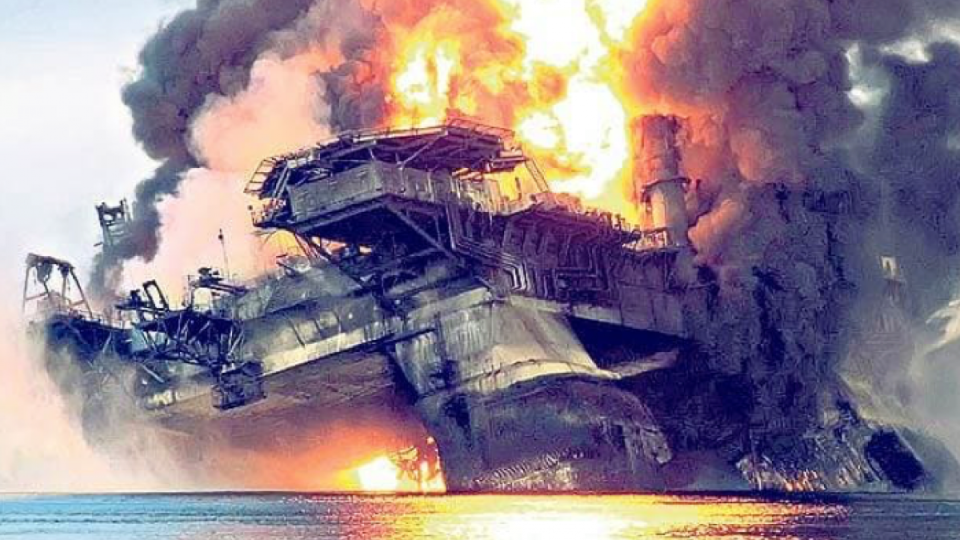






MARINE COROSSION AND PROTECTION (Part 2)
Continuing on MARINE COROSSION AND PROTECTION (Part 1) that we discussed about the Electro-chemical corrosion protection methods and the last remained one is called ICCP system. Reversing the current by creating an opposite potential ( ICCP : Impressed current corrosion protection ) The ICCP system, a large positive current is applied to hull and pass through the adjacent water. As a result, current flow into ship’s steel whereas it has a direct unprotected contact with seawater and inducing a Cathodic reaction that protect the steel against the corrosion. To achieve this, the Rectifier (convert AC–>DC) is connected to ship’s steel with … Continue reading MARINE COROSSION AND PROTECTION (Part 2)

MARINE COROSSION AND PROTECTION (Part 1)
To understand how marine corrosion protection works, it’s necessary to look in more detail in to the corrosion process. In this undesired chemical effect, the material can reach with different chemicals in its surroundings. The reaction can be divided into: Chemical reaction Electro-chemical reaction These reaction take place exclusively at the surface of material. It’s possible the microscopic pits are formed by corrosion on the metal’s surface.The corrosion can also occur in existing crack. CHEMICAL REACTION In chemical reaction, there’s a charge transfer between the reactions. If the exchange of charge is local effect, then the resulting ” Chemical corrosion … Continue reading MARINE COROSSION AND PROTECTION (Part 1)

MEGGER/RESISTANCE TEST
Megger test is the test that evaluate the insulation resistance quality. Insulation starts to age as soon as it’s made. As it ages, its insulating performance deteriorates. Any harsh installation environments, especially those with temperature extremes and/or chemical contamination, accelerates this process. This deterioration can result in dangerous conditions in power reliability and personnel safety. As such, it’s important to identify this deterioration quickly so that corrective steps can be taken. One of the simplest tests and its required test instrument are not universally understood. To help eliminate this lack of understanding, let’s discuss in detail Insulation Resistance (IR) testing … Continue reading MEGGER/RESISTANCE TEST

Circuit Fault and Electric integrity protection.
There’re three general faults in electric integrity, one by one to go through and we will understand the basic concept of electric installation. Open circuit Fault Due to the broken of conductor (Wire broken) Open circuit will cause the 3-phase Motor stop (Over load relay will trip the motor if the current is over the normal ). Some case the load will be increase on the remain 2-phase and burn out the motor. Protection: Do the Megger check between one point to the earth ( The wire earthed at one end already ). The result is infinity mean … Continue reading Circuit Fault and Electric integrity protection.

PUMP PRIMING (Notes)
When the centrifugal pump is not primed ( filled with liquid ) before starting, the air pocket inside the pump case may give rise to formation of vortex and discontinuity of flow those lead to make noise, vibration and damages to the impeller. Priming is done by pouring liquid in to pump casing ( when pump is not running ) through a funnel and air will be displaced through an air vent provided on pump case. The formation of air pocket inside casing can be avoided by following methods: 1 – Installation of pump below the suction level 2 – … Continue reading PUMP PRIMING (Notes)

CENTRIFUGAL PUMP (Advanced)
There’re some confusing fluid mechanic principles, you may understand it during learning individually. Meanwhile, it’s real difficult and daunting to gather and compile all the theories to design a reasonable pump configuration as the demand. In this post, we’ll break down the anatomy of all concept through the centrifugal pump curve (Characteristic curves). The pump characteristic curve shows the performance of a pump. It usually shows TDH-Total dynamic Head, Power, Efficiency and NPSHr plotted over Flow rate at a given RPM. In these diagrams you can estimate pump behavior at constant speeds and a range of impeller diameters. Constant horsepower, … Continue reading CENTRIFUGAL PUMP (Advanced)

CENTRIFUGAL PUMP (Introduction)
Well for the inspectors, trainees, and freshers who just move into the piping systems will have their introduction, with fluid transporting devices which are mainly “PUMPS“. Almost piping system have the basic and the mostly optimized device know as centrifugal pump those are handled easily and it is cheaper when compared to other pumping devices, even maintenance cost is much lesser than the others. But the LIMITATION ( •cannot handle entrained air – 3%max •cannot handle viscous liquids) THERE’RE 5 MAIN PUMP STYLES: 1-Horizontal Split Case good wear resistance (Mean of higher price ) suction and inlet are opposite high head pressure ( Cooling … Continue reading CENTRIFUGAL PUMP (Introduction)

SHIP TONNAGE AND HYBRID MEASUREMENT
Everyone who has looked at specifications for ships is often bewildered by the many different tonnages used for the same ship as DWT, GT, NT, LWT ect., Visit: Shipbuilding Knowledge A-Z for more free topics on shipbuilding An ocean ship may have different gross tonnage, depending on which country’s rules were used in determining the weight. Below is a good explanation on just what the tonnages for ships really are. TONNAGE (DWT, Displacement, Lightweight) Lightweight (LWT, LDT or LWDT) Basically the weight of the ship itself with no cargo, stores etc. Used widely at the time vessels are negotiating for scrap … Continue reading SHIP TONNAGE AND HYBRID MEASUREMENT
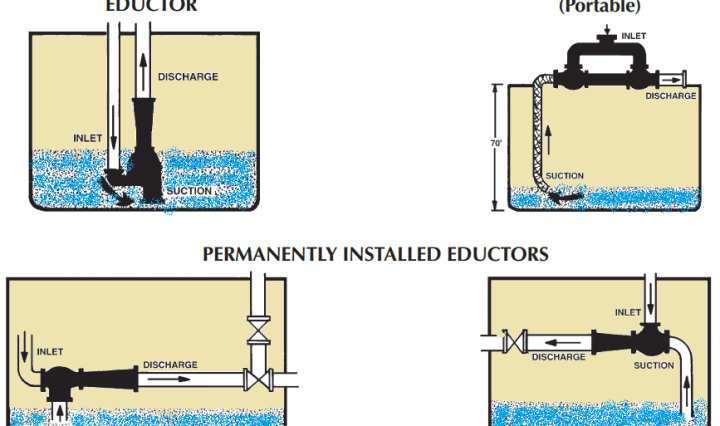
EDUCTOR AND EJECTOR – in shipbuilding, industrial (How to distinguish, calculation, selection, and purchasing)
At the beginning, there’s no need to fret over the differences that the different is in the motive fluid: An ejector uses a gas phase motive, usually steam or air. An eductor uses a liquid phase motive, usually water. Eductors/Ejectors … Continue reading EDUCTOR AND EJECTOR – in shipbuilding, industrial (How to distinguish, calculation, selection, and purchasing)
 AMARINE