Stainless Steel Material In Sea Water

Other Topic: Duplex piping and seawater With this topic we will discuss about Corrosion resistance of Austenitic stainless steel in Sea water. 1) Sea water: Seawater is water from a sea or ocean. Sea water in the world’s oceans has a salinity of approximately 3.5%, or 35 parts per thousand. This means that for every 1 litre (1000 mL) of seawater there are 35 grams of salts (mostly, but not entirely, sodium chloride) dissolved in it. Although a vast majority of seawater is found in oceans with salinity around 3.5%, seawater is not uniformly saline throughout the world. 2) Chlorides: The … Continue reading Stainless Steel Material In Sea Water

ODME – What is ODME? (Part 2)

How does ship crew operate ODME??? ODME is required under Marpol Annex I, which deals with pollution aspects related to oil cargoes. For easy understand how does it work? We will take an example: a product tanker of 21.8000 DWT which has just discharged an oil cargo of 15000 MT (16000 m3 @ 15 C). This tanker need to clean these tanks which were carrying total oil cargo of 15000 MT. How to proceed with cleaning and decanting the slops with ODME ? It has some below steps: 1 – Set the total oil quantity in ODME: Marpol has put a … Continue reading ODME – What is ODME? (Part 2)

ODME – What is ODME? (Part 1)

1) What is ODME? O.D.M.E is Oil Discharge Monitoring Equipment which is used to check and monitor oil is discharged follow related rule ( MARPOL 73/78 ) when a tanker discharges the sea water from the slop tank where sea water used to clean the tanker after unloading the cargo to be prepared to ship other kind of cargo has been stored. “Oil” means all kinds of oil including crude oil, heavy oil, sludge, waste oil and refined oil. ODME is to remove water from the slops and not as much oil as is allowed also. 2) Condition to discharge oil into … Continue reading ODME – What is ODME? (Part 1)

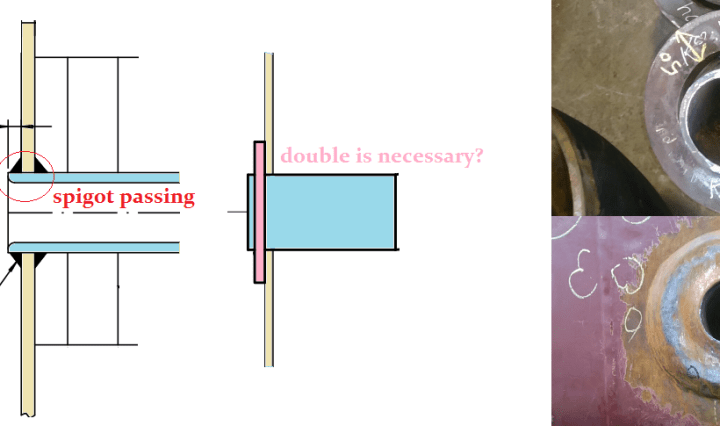
SPIGOT TYPE OF PENETRATION (Explanation and design at side shell concept)

In shipbuilding terminology, a definition of spigot type is commonly used for the pipe penetration through the bulkhead or side shell. To understand the meaning of spigot type is necessary because of most pipe penetrations on ship leading to side … Continue reading SPIGOT TYPE OF PENETRATION (Explanation and design at side shell concept)

Stainless Steel Pipe Inspection Notes!- Part 2

Continue:        7. Non Destructive Test: base on rule, % welding joint need to do NDT will be choosen. For ex: (1)  Apply at least 10% of random RT to butt joint based on the class rule. (Choose RT point upon the decision of QM) (2)  Apply 100% of random RT to stern cargo line 8. Pipe Covering / Protection (1)  After the inspection of pipe at shop and before the coating process, do the covering to the tip of the pipe based on sealing rule. This can protect the pipe from foreign substance influx. (2)  After the coating … Continue reading Stainless Steel Pipe Inspection Notes!- Part 2

Stainless Steel Pipe Inspection Notes!- Part 1

Range of Application This guideline applies to stainless steel piping work during the fabricate & installation on board. Purpose Stainless steel pipe is widely used for its strength against low temperature and corrosion, and it is mainly used for low-temperature and chemical products. To maintain these characteristics, special management is required in the process of storage, assembly, welding, and post-processing. The purpose of this guideline is to offer standardized working methods to maintain the proper quality of piping system. Definition Sus pipe is composed of austenite and it is extremely durable against low / cryogenic temperature. Cr₂O₃ is formed on … Continue reading Stainless Steel Pipe Inspection Notes!- Part 1

PIPE FLUSHING INSPECTION NOTES

Range of Application This test is to clean pipes inside of M/E L.O serv’ system, M/E & G/E F.O serv’ system, stern tube L.O system, and hydraulic oil system. Purpose This test is to heat and pump flushing oil or system oil and circulate through pipes. Circulating through pipes removes substances such as rust, dust, slga and grit using filter installed inside. The test helps devices to clean themselves and protect from aging and damaging, and also to lengthen the span of life of the machines. Flushing Line and the General Fact 1) Stern Tube L.O System ⓐ Do disguised … Continue reading PIPE FLUSHING INSPECTION NOTES

Water hammer in piping system ( Part 2 )

We continue with remain one for Water hammer: 5.  HOW CAN THE CONSEQUENCES OF WATER HAMMER BE AVOIDED? – STRONGER PIPES AND SUPPORTS: Long pipes are where water hammer problems are most likely. Making such pipes sufficiently strong to withstand water hammer pressures and forces is unlikely to be economic. Most pipes in good condition can withstand pressures well in excess of their design pressure for short periods of time. Given also the subtlety of the dynamics of pipe responses to transients it is often true that bursting the pipe is not the main concern of the pressure surge engineer. … Continue reading Water hammer in piping system ( Part 2 )