


API 510 Questions and Answers (ASME VIII – Internal & External Pressure)
After completed the Part 2: Static Head, we will continue to try on the Open/Close questions on Module ASME VIII – Internal/External Pressure as a part of in-the-exam API 510 Body of knowledge (BOK) If you don’t know how API 510 Certification scheme, … Continue reading API 510 Questions and Answers (ASME VIII – Internal & External Pressure)
API 510 Questions and Answers (ASME VIII – Static Head)
After completed the Part 1: Joint Efficiency, we will continue to try on the Open/Close questions on Module ASME VIII – Static Head as a part of in-the-exam API 510 Body of knowledge (BOK) If you don’t know how API 510 Certification … Continue reading API 510 Questions and Answers (ASME VIII – Static Head)
API 510 Questions and Answers (ASME VIII – Joint Efficiency)
In this very first and priority topic, we will try one by one (Don’t jump the question, you will be confused of extremely complex-headaches definitions and concepts on API 510 certification program) of the Open/Close questions on Module ASME VIII … Continue reading API 510 Questions and Answers (ASME VIII – Joint Efficiency)
API 510 Certification Instructions
Certified API 510 Pressure Vessel inspectors (Salary rate 350-500usd/day) must have a broad knowledge base relating to maintenance, inspection, repair, and alteration of pressure vessels. The API 510 examination is designed to determine if individuals have such knowledge. To help you … Continue reading API 510 Certification Instructions

Steel Pipe ASTM A53 B vs ASTM A106 B
ASTM A53 and 106 is vastly applied in general industrials, sometime it can be switched to each other as an alternative. This article will highlight some key different that will help you to identify the risks in material selection between A53 and A106 The scope of ASTM A106 and A53 ASTM A53 specification covers the steel pipe manufacturing types in seamless and welded, material in carbon steel, black steel. Surface natural, black, and hot-dipped galvanized, zinc coated steel pipe. Diameters range from NPS 1⁄8 to NPS 26 (10.3mm to 660mm), nominal wall thickness. ASTM A106 standard specification covers the seamless carbon steel … Continue reading Steel Pipe ASTM A53 B vs ASTM A106 B

What is Concrete coating pipe (CWC Pipe)
The concrete coated pipe also called concrete weight coating pipe (CWC pipe), it is the steel pipe external with concrete weight coating (Mixed with cement, aggregates, reinforced steel mesh, and water), to provide strong downward force protection (Impact from anchoring, dredging activity, fishing, ship sinking) or a negative buoyancy for the pipelines. This pipe is commonly used in sub-sea (submarine) pipelines, with adding the proper weight of the concrete coatings to support a resistant pressure against seawater. Concrete coated pipe types and dimensions For to use in different circumstances in the sub-sea environment, the pipe could be in different dimensions, … Continue reading What is Concrete coating pipe (CWC Pipe)

What is Pitting Mechanism and Prevention
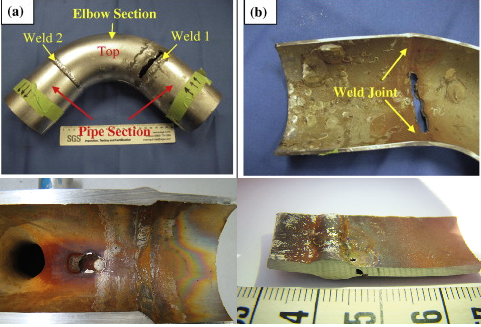
As discussed in earlier post <<What is PREN value for pitting corrosion?>>, pitting corrosion is one of the most common localized corrosion attack and most destructive form of corrosion in metal and alloy. In article will explain generally about the mechanism and prevention of pitting corrosion: Pitting Corrosion on Metal SurfacePitting is one of the most destructive forms of corrosion as it will potential cause equipment failures due to perforation / penetration. pitting generally occurs on metal surfaces protected by oxide film such as Stainless steel, aluminum, etc. Typically for boiler and feed water system, pitting corrosion rate increase dramatically with the … Continue reading What is Pitting Mechanism and Prevention
PREN number calculation formulas
As discussed in earlier post <<What is PREN value for pitting corrosion?>>, pitting corrosion is one of the most common localized corrosion attack and most destructive form of corrosion in metal and alloy. Out of so many type of alloy, … Continue reading PREN number calculation formulas

What is PREN value for pitting corrosion?
Despite its inherent resistance to corrosion, stainless steel tubing installed in a marine environment suffers from different types of corrosion throughout its expected lifetime. Such corrosion can lead to fugitive emissions, lost product, and potential risks. Offshore platform owners and operators can reduce corrosion risks at the outset by specifying more robust tubing materials that offer better corrosion resistance. Later, they must remain vigilant in their inspections of chemical injection, hydraulic, and impulse lines, as well as process instrumentation and sensing equipment, to ensure corrosion isn’t threatening the integrity of the installed tubing and impacting safety. Localized corrosion can be … Continue reading What is PREN value for pitting corrosion?
 AMARINE