





Free Board Mark Construction & Inspection
The following regulations concern the process, testing guidelines, and testing criteria for freeboard marking which is done on the outer surface of the shell during ship construction. Before to read this article, you may read the relevant definitions at DRAUGHT MARKS AND SURVEYING. Purpose The purpose of this article is to test and manage quality by accurately regulating methods and standards of measurement, as well as to maintain measurement accuracy in the location, size, and measure of the freeboard marking process performed by ship according to floor plans based on I.M.O regulations and class requirements. Terminology Freeboard Refers to the perpendicular … Continue reading Free Board Mark Construction & Inspection

Draft Mark (Draught Mark) Inspection
The following regulations concern the method, testing guidelines, and testing criteria for draft marking which is done on the outer surface of the shell during ship construction. Purpose The purpose of this article is to ensure quick and accurate testing and management by establishing the procedural criteria and methods for draft marking on different ship and locations. Terminology Draft Mark: This term refers to the perpendicular distance from the lowest point of the keel plate to the water surface.; there are three types, which are aft draft mark, mid-draft mark, and fwd-draft mark. Draft markings are necessary for calculating the … Continue reading Draft Mark (Draught Mark) Inspection
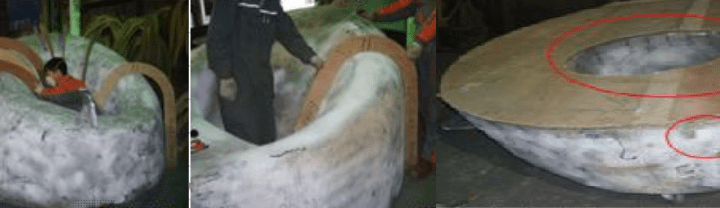
Protected: Ship Bell Mouth (Anchor Mouth) Inspection (How it casting, defect, NDT, tolerances, techniques)
There is no excerpt because this is a protected post. Continue reading Protected: Ship Bell Mouth (Anchor Mouth) Inspection (How it casting, defect, NDT, tolerances, techniques)

Accommodation Ladder & Pilot Ladder
An accommodation ladder is a portable ladder hinged to a platform attached to the side of a ship and which can be positioned to provide access between ship and shore. Telescopic accommodation ladder is used for covering a long distance between the vessel and port quay. According to amendments to SOLAS Convention ships constructed on or after 1 January, 2010 shall be provided with means of embarkation on and disembarkation from ships for use in port, such as gangway and accommodation ladders Applicable Scope This inspection standard shall be applied to ACC. ladder onboard test carried out in the inner wall after … Continue reading Accommodation Ladder & Pilot Ladder

VORTEX SHEDDING PREVENTION
This Topic is support or building the fundamental knowledge to investigate and access the scour development and vibration around the offshore foundation and the others. In fluid dynamics, vortex-induced vibrations (VIV) are motions induced on bodies interacting with an external fluid flow, produced by – or the motion producing – periodical irregularities on this flow. They occur in many engineering situations, such as bridges, stacks, transmission lines, aircraft control surfaces, offshore structures, thermo-wells, engines, heat exchangers, marine cables, towed cables, drilling and production risers in petroleum production, mooring cables, moored structures, tethered structures, buoyancy and spar hulls, pipelines, cable-laying, members of jacketed structures, and other hydrodynamic and hydroacoustic … Continue reading VORTEX SHEDDING PREVENTION

Welding Engineer & Welding Metallurgy Fundamental
Hey! we are going to start the topics, Please follow this site to get further notification of new post. Welding Engineer Fundamental: The very first step to becoming a welding engineer that to understand how the Welding operation, terminology, set-up, … Continue reading Welding Engineer & Welding Metallurgy Fundamental

IMO NUMBER & NET TONNAGE MARKS PLAN
IMO SHIP IDENTIFICATION NUMBER SCHEME (Circular letter No.1886/Rev.5) The IMO ship identification number scheme was introduced in 1987 through the adoption of resolution A.600(15), as a measure aimed at enhancing “maritime safety, and pollution prevention and to facilitate the prevention of maritime fraud”. It aimed at assigning a permanent number to each ship for identification purposes. That number would remain unchanged upon transfer of the ship to other flags (s) and would be inserted in the ship’s certificates. When made mandatory, through SOLAS regulation XI/3 (adopted in 1994), specific criteria of passenger ships of 100 gross tonnages and upwards and … Continue reading IMO NUMBER & NET TONNAGE MARKS PLAN

SHIP DOCKING PLAN
Docking Plans: A docking plan is a document that is prepared for every ship during its preliminary design phase. All the information required to bring a ship to a dry dock is included in its docking plan. While most of the information is condensed into drawings, one must also refer to the textual references and notes provided, because they also inform us about the type of dry dock that is being used and technical specifications of dry dock that should be met before the ship is docked. Visit: Shipbuilding Knowledge A-Z for more understanding shipbuilding. The contents of a typical docking plan are … Continue reading SHIP DOCKING PLAN

SHIP CAPACITY PLAN & DEADWEIGHT SCALE
Capacity Plan A plan of the spaces available for cargo, fuel, freshwater, water ballast, etc, and containing cubic or weight capacity lists for such spaces and a scale showing deadweight capacities at varying draughts and displacements. Visit: Shipbuilding Knowledge A-Z for more understanding on shipbuilding DWT Scale This scale also shows the moment to change trim 1 cm and the TPC for each draught; a diagram with measurements of winter, summer, tropical and freshwater load-line with a diagram of the position of the deck line; this is usually placed alongside the deadweight and displacement scale so that the deadweight or displacement … Continue reading SHIP CAPACITY PLAN & DEADWEIGHT SCALE
 AMARINE