



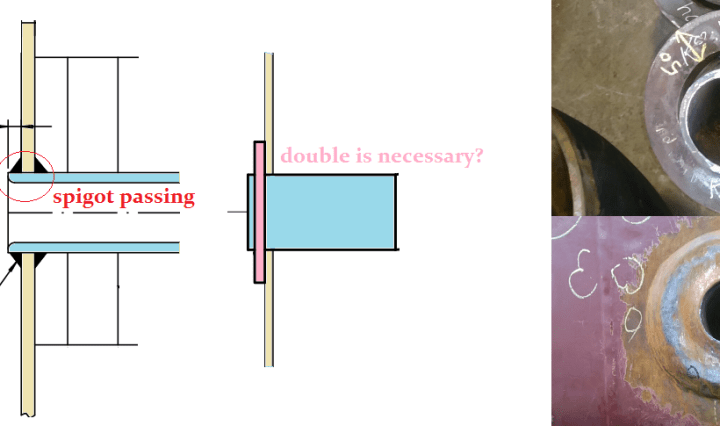
SPIGOT TYPE OF PENETRATION (Explanation and design at side shell concept)
In shipbuilding terminology, a definition of spigot type is commonly used for the pipe penetration through the bulkhead or side shell. To understand the meaning of spigot type is necessary because of most pipe penetrations on ship leading to side … Continue reading SPIGOT TYPE OF PENETRATION (Explanation and design at side shell concept)

CSWIP 3.1: Question with Answer and Explanation – Part 1
You may continue to read on CSWIP 3.1: Question with Answer and Explanation – Part 2 1) A code give the acceptance standard for excess weld metal “h” as h ≤ 1mm + 0.1b, max. 5mm, where “b” is the width of the weld cap. For which of the following situations is the excess weld metal acceptable? a. b = 15 h = 3.0 b. ( answer ) b = 22 h = 3.0 c. b = 28 h = 4.0 d. b = 40 h = 5.4 from b = 22 –> h<=3.2 < 3.0. So, “b” is righ answer. … Continue reading CSWIP 3.1: Question with Answer and Explanation – Part 1

CSWIP 3.1: Part 3 – Welding Terminology and Definitions
We need to know these tern & define as below: 1) What is a Weld? A union between materials caused by heat, and or pressure Joint weld: Types of weld Preparation: Weld Zone Terminology: Butt Weld Features: Fillet Weld Features: 2) What is a Joint? – A configuration of members – Types of Joint type: – Types of Joint Preparation: 3) Welding Positions: Question: QU 1. Sketch a single-U butt joint and indicate the following a. Root face b.Root gap c.Included angle d. Root radius See above QU 2. Sketch a tee joint, fillet welded and indicate the following a. Leg length … Continue reading CSWIP 3.1: Part 3 – Welding Terminology and Definitions

CSWIP 3.1: Part 2 – Typical Duties Of Welding Inspectors
Duties and Responsibilities: 1) Give the three main responsibilities of a Welding Inspector: Code compliance Workmanship control Documentation control 2) Give the main attributes, which all Welding Inspectors must possess: Honesty Integrity Knowledge Good communicator Physical fitness 3) A Welding Inspector should refer to What documents and records: Welding Inspection Personnel should: be familiar with relevant standards, rules and specifications applicable to the fabrication work to be undertaken. For ex: BS EN 970 – Non-destructive examination of fusion welds – Visual examination be informed about the welding procedures to be used have good vision (which should be checked every 12 months) 4) Give main … Continue reading CSWIP 3.1: Part 2 – Typical Duties Of Welding Inspectors

Stainless Steel Material: what is pickling / passivation?
Stainless Steel material: ( refer to other topic: what is stainless steel? ) A metallic alloy (i.e., metal made of multiple elements such as chromium, nickel, and molybdenum) is generally considered to be “stainless” when its chromium content is greater than about 12 percent by weight ( some document mention it is about 10.5% chromium ), with the balance being iron, higher alloyed stainless steels have higher levels of chromium. Chromium provides corrosion resistance to these alloys by forming a thin, adherent, corrosion-resistant oxide film on a clean (e.g., pickled, wire/rotary brushed, or ground) surface (of the alloy). The main … Continue reading Stainless Steel Material: what is pickling / passivation?

HULL SURVEY – WELDING STANDARD
The welding joint’s configuration and their profile are playing a vital role in ship hull structure integrity. In this article I’d like to reveal some noted points which will be regularly observed during inspection. JOINT TOLERANCES AND REMEDIAL ACTIONS: 1-Butt joint: 2-Fillet joint 3-Lap joint 4-Special note: Fillet leg size for main longitudinal The fillet weld is to be fully penetrated, otherwise fillet size is to be equivalent to the sectional area of the longitudinal members. General fillet size F1,F2 Frame of bulk carrier Bilge Keel & Pillar End Sheer strake and deck Welding at high stress area For … Continue reading HULL SURVEY – WELDING STANDARD
Protected: HULL SURVEY – WELDING CONTROL (Erection, run-off tabs, collar plate, scallop assembly and weld sequence, plate inserts)
There is no excerpt because this is a protected post. Continue reading Protected: HULL SURVEY – WELDING CONTROL (Erection, run-off tabs, collar plate, scallop assembly and weld sequence, plate inserts)

CSWIP 3.1 ( Welding Inspection ): Part 1 – What is it?
Dear all, With this topic, we will talk about CSWIP with a series as much as possible. Part 1: CSWIP – What is it? CSWIP is Certification Scheme for Welding & Inspection Personnel. The CSWIP 3.1 Welding Inspector course provides an introduction to a wide range of topics related to Welding Inspection and Quality. Course Contents: Roles and duties of a Welding Inspector Welding Defects Mechanical Testing Main Welding Processes Welding Symbols Non-Destructive Testing Inspection Reporting Welding Terminology Welding Safety Heat Treatments Weldability of Steels Joint Design Welding Procedures Welder Qualification Stress and Distortion Macro Examination Codes and Standards Welding Consumables … Continue reading CSWIP 3.1 ( Welding Inspection ): Part 1 – What is it?

Why Stainless steel rust / corrosion? – Part 2 – Other corrosion.
In Part 1, we know about Pitting corrosion. We will continue with remain one: 2) Crevice ( gap ) corrosion– Stainless steel requires a supply of oxygen to make sure that the passive layer can form on the surface. In very tight crevices, it is not always possible for the oxygen to gain access to the stainless steel surface thereby causing it to be vulnerable to attack. Crevice Corrosion refers to the localized attack on a metal surface at, or immediately adjacent to, the gap or crevice between two joining surfaces. The gap or crevice can be formed between two metals or a … Continue reading Why Stainless steel rust / corrosion? – Part 2 – Other corrosion.
 AMARINE