


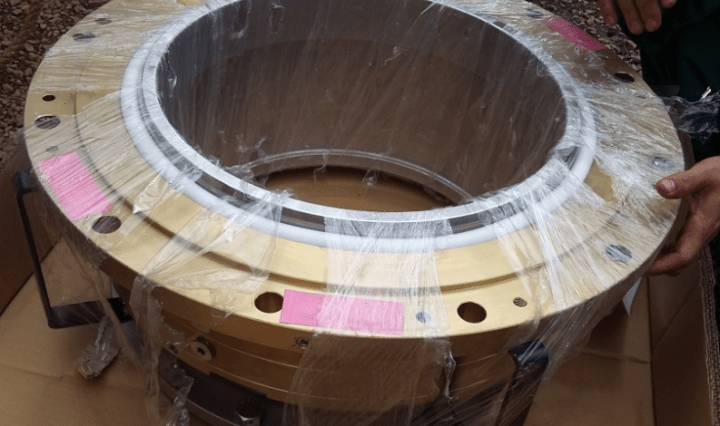
Protected: Propeller System: Shaft seal ( Stern Tube seal ) Inspection Notes on (Wear-down, Alignment, L/O lines, Seals, contact, leak test, and installation tolerance)
There is no excerpt because this is a protected post. Continue reading Protected: Propeller System: Shaft seal ( Stern Tube seal ) Inspection Notes on (Wear-down, Alignment, L/O lines, Seals, contact, leak test, and installation tolerance)

Stainless Steel Pipe Inspection Notes!- Part 2
Continue: 7. Non Destructive Test: base on rule, % welding joint need to do NDT will be choosen. For ex: (1) Apply at least 10% of random RT to butt joint based on the class rule. (Choose RT point upon the decision of QM) (2) Apply 100% of random RT to stern cargo line 8. Pipe Covering / Protection (1) After the inspection of pipe at shop and before the coating process, do the covering to the tip of the pipe based on sealing rule. This can protect the pipe from foreign substance influx. (2) After the coating … Continue reading Stainless Steel Pipe Inspection Notes!- Part 2

Stainless Steel Pipe Inspection Notes!- Part 1
Range of Application This guideline applies to stainless steel piping work during the fabricate & installation on board. Purpose Stainless steel pipe is widely used for its strength against low temperature and corrosion, and it is mainly used for low-temperature and chemical products. To maintain these characteristics, special management is required in the process of storage, assembly, welding, and post-processing. The purpose of this guideline is to offer standardized working methods to maintain the proper quality of piping system. Definition Sus pipe is composed of austenite and it is extremely durable against low / cryogenic temperature. Cr₂O₃ is formed on … Continue reading Stainless Steel Pipe Inspection Notes!- Part 1

PIPE FLUSHING INSPECTION NOTES
Range of Application This test is to clean pipes inside of M/E L.O serv’ system, M/E & G/E F.O serv’ system, stern tube L.O system, and hydraulic oil system. Purpose This test is to heat and pump flushing oil or system oil and circulate through pipes. Circulating through pipes removes substances such as rust, dust, slga and grit using filter installed inside. The test helps devices to clean themselves and protect from aging and damaging, and also to lengthen the span of life of the machines. Flushing Line and the General Fact 1) Stern Tube L.O System ⓐ Do disguised … Continue reading PIPE FLUSHING INSPECTION NOTES
How to view the material certificate? – Part 3 ( Final part )
Continue: PART 3 – Fake certificate: Why have the FAKE CERT? The Certified Mill Test Report is a tool used to ensure that received raw material matches the engineering and purchase order requirements. There are clear requirements for what should go on the certificate but every so often someone tries to produce a fake mill certificate to sell steel plates fraudulently. 2. How to identify a FAKE STEEL MTCS? A fake mill certificate is normally fairly easy to spot if you know what you are looking for. You can sent them an email asking to vendor to clarify this certificate. … Continue reading How to view the material certificate? – Part 3 ( Final part )

How to view the material certificate? – Part 2
Continue: PART 2 – How to view the certificate??? We will take example for Mill cert’, other cert’ is same procedure. Mill cert: A Certified Mill Test Report (CMTR) is a quality assurance document generated by the raw material manufacturer and provided with the material to intermediate suppliers and ultimately to a finished goods manufacturer. Whether it’s called a CMTR, Mill Test Report (MTR), Mill Certification, Metallurgical Test Report, or similar name, this document provides the end user of the raw material verification that the material received matches the requirements of their order. CMTRs are also used to maintain traceability … Continue reading How to view the material certificate? – Part 2

TACK WELDER
Tack welding is a major part of welding which are used as a temporary means to hold the components in the proper location, alignment, and distance apart, while welding. The engineers use high heat input process for the welding and the tack is applied by the shielded metal arc welding process. The tack is a very rapid quench application and a brittle, crack sensitive micro structure results usually at the root of the weld. There’re two type of tack-welds as defined in below attached file ( Temporary & Incorporated ) TACK WELDS For saving the qualification cost, some yard make … Continue reading TACK WELDER

WELDING INTERRUPTION
Definition – Interruption of welding means dropping from preheat temperature to ambient temperature prior to completion of welding or performing PWHT. This aspects most applied on high heat-sensitive material like (P3, P4, P5A, P5C, 10H High alloy materials) with regarding to Cold cracking or HIC. The weld can be interrupted and the weld may be allowed to cool prior to post weld heat treatment, provided the following conditions are satisfied: 1. A minimum of 3/8 in. thickness of weld is deposited or 25% of the welding groove is filled, whichever is greater 2. The weld is allowed to cool slowly … Continue reading WELDING INTERRUPTION

WELD PROXIMITY
Purpose of Welding proximity requirement is: 1 – To avoid the overlapping HAZ, the lowering of the welding HAZ mechanical properties which is not covered in WPS is approved for welding configuration. 2- To avoid the duplicate of residual stress between two joints which may combine with the load during service, this leads to structural failure due to the total combined local stress exceeding allowable stress. Weld proximity is covered by a number of international standards. Extracts from these standards are shown below and summarized in the following table: Standard Applies to The minimum distance between weld toes Notes BS … Continue reading WELD PROXIMITY
 AMARINE