



FCAW Welder may be qualified by volumetric NDE?
During reading between code D1.1 & ASME IX, a confusion point about welder qualification testing method RT/UT can be carried out in spite of Bend test. Note: From Asme IX extract, there’s no mention about the RT test can be used as alternatives for welder qualification in FCAW process. But as per the Interpretation, it can be used. ENJOY! Note that: If the welding with unlist material, the procedure of Welder qualification to be follow as required in table 452.1 (a) Continue reading FCAW Welder may be qualified by volumetric NDE?

GTAW CS TO SS SOLUTION
NOTE: APPLYING ONLY ON ASME IX GTAW PIPING WELDING Some contractors use the essential variable tables (QW-352 thru 357) to minimize their costs. For instance, they might test the welder for stainless steel material by using carbon steel material. Consider the actual project material is stainless steel and you do not want to waste stainless steel material for testing. You ask the welder to weld in carbon steel material but with stainless steel filler metal. Based on the essential variable table P number 1 (Carbon Steel) qualifies P 8 (Stainless Steel), and the F number is the same. So you … Continue reading GTAW CS TO SS SOLUTION

WELDING POSITION AND WPQR VARIABLES
The most common control points for welder performance are: Welding position Base metal F-No of Electrode/Filler Backing inert condition Pre-Heating prior to next weld (special interval between shifts) Electrode storage condition The qualified thickness Refer to the ASME IX & D1.1 extract as below: D1.1 WELDER PERFORMANCE POSITION AND VARIABLES IX WELDER PERFORMANCE POSITION AND VARIABLES Key Note on Down-hill welding: Normally, the Downhill welding should be avoided in design to prevent any mis-observed defects and make it sound welding practices on-board. Following the Code requirement, the changes in welding position is extracted as below: ASME IX : Down-hill welding … Continue reading WELDING POSITION AND WPQR VARIABLES

DT & NDT specifying for PQR
WPS/PQR Qualification The WPS for both the main welding procedures and weld repair procedures an oil and gas project shall be submitted by CONTRACTOR to Client / COMPANY normally one month minimum before the point of qualification tests. The WPS shall be accompanied by a summary table showing: process, consumables, direction of welding, type of weld, WPS no., test weld wall thickness and scope of qualification. The welding procedure qualification tests shall not be undertaken until the COMPANY Inspector (COMPANY’S authorized representatives or members) has given his approval of the principle on the said WPS. CONTRACTOR shall demonstrate by qualification … Continue reading DT & NDT specifying for PQR

From PQR to WPS – Introduction
Here is the shortcut to understand the step by step that how to make a WPS with the initial information supplied from contract specification. DEFINITION Welding Procedure Specification (WPS) : A WPS is a written qualified welding procedure prepared to provide direction for making production welds to code requirements. Procedure Qualification Record (PQR) : A PQR is a record of the welding data used to weld a test coupon. Test Coupon : A weld or Braze assembly for procedure or performance qualification testing. The coupon may be any product from plate, Pipe, tube, etc., and may be a fillet weld, … Continue reading From PQR to WPS – Introduction

How to view the material certificate? – Part 1
Base on EN – 10204 ( version 2004 ) & EN – 10168 ( for steel products ): We will go to know about some points as below: Part 1 – Know about what type of certificate: PART 2 – How to view the certificate: PART 3 – Fake certificate EN10204 HISTORY: EN 10204 originally started off as DIN 50049 which was a German DIN standard specifying the test certificate requirements for metallic products. I. Part 1 – Know about what type of certificate: A. Scope: The EN-10204 specifies the different types of inspection documents supplied to the purchaser, in accordance with … Continue reading How to view the material certificate? – Part 1

Water hammer in piping system ( Part 2 )
We continue with remain one for Water hammer: 5. HOW CAN THE CONSEQUENCES OF WATER HAMMER BE AVOIDED? – STRONGER PIPES AND SUPPORTS: Long pipes are where water hammer problems are most likely. Making such pipes sufficiently strong to withstand water hammer pressures and forces is unlikely to be economic. Most pipes in good condition can withstand pressures well in excess of their design pressure for short periods of time. Given also the subtlety of the dynamics of pipe responses to transients it is often true that bursting the pipe is not the main concern of the pressure surge engineer. … Continue reading Water hammer in piping system ( Part 2 )

Water hammer in piping system ( Part 1 )
What is water hammer? Water hammer is a pressure surge or wave resulting when a fluid in motion is forced to stop or change the velocity. A water hammer commonly occurs when a valve closes suddenly at an end of a pipeline system, and a pressure wave propagates in the pipe. It is also called hydraulic shock. A signifcant, nearly instantaneous pressure shock wave may be generated when a valve opens or closes too quickly, or when a pump starts with an empty discharge line or suddenly shuts down. This phenomenon is the result of the sudden change in velocity of the fluid … Continue reading Water hammer in piping system ( Part 1 )
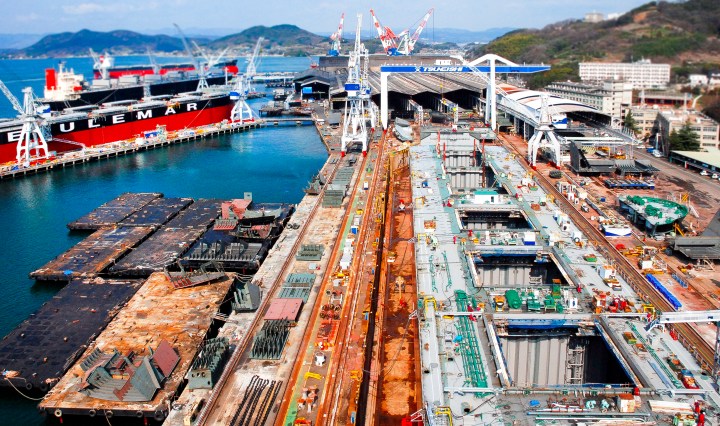
New Shipbuilding Knowledge from Design to Construction
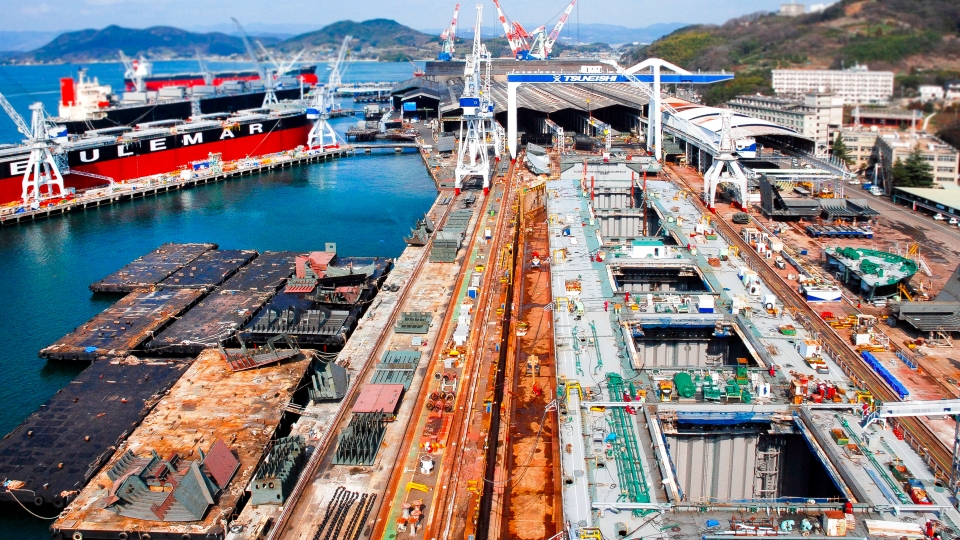
For first sight on Shipbuilding engineering knowledge, it’ll be more easy to understand what/how the ship be built in a yard from design to delivery by overview one typical Shipyard’s organization: SHIPBUILDING ENGINEERING ORGANIZATION Hereby the Essential knowledge points list … Continue reading New Shipbuilding Knowledge from Design to Construction
 AMARINE