



PIPE API 5L: PSL1 vs PSL2
API 5L Pipe general: API 5L pipes is used for conveying gas, water and oil either in the oil or natural gas industries. Line pipe can meet all requirement of high-pressure transmission pipeline for natural gas & petroleum, can be used in on-shore, off-shore oil & gas transmission. API 5L ~ American Petroleum Institute specification API 5L cover seamless or welded steel line pipe. The purpose of this specification is to provide standards for pipe suitable for use in conveying gas, water, and oil in both the oil and natural gas industries. Grade: Grades covered by this specification are A25, A, … Continue reading PIPE API 5L: PSL1 vs PSL2

Welding Inspector & WPS (PART 3)
PART 3: FILLER METAL VARIABLES Filler metal variable is very sensitive item in WPS those mainly affect to the weldment mechanical and properties. Ideally, all the variables have to be kept as the same with PQR. There’re still some flexible gap, however, the below experienced lesson learns may help to resolve the common problems with WPS those relating to the changes of Filler metal variables. Key Notes: * ASME IX QW 404.12 vs 404.33 – AWS specification changed. * AWS D1.1 THE ABILITY TO RESOLVE ABOVE PROBLEMS IS LESS POSSIBLE (WE CAN CHANGE THE BRAND NAME OR REDUCE FILLER STRENGTH … Continue reading Welding Inspector & WPS (PART 3)
Welding Inspector & WPS (PART 2)
PART 2 : BASE MATERIAL VARIABLES Key Notes: * WPS – CVN with min.thickness is 16mm (ASME IX & AWS D1.1) * AWS D1.1 ONLY: TAB 4.1 –> (28) Diameter range for pipe welding is > 600 mm (24 inch) * Example of ASME IX 11&5 QUESTION: How about the unlisted material like SS400 Flange welded to API 5L pipe * Example of AWS D1.1 29&1 SPECIAL NOTE: ASME IX only! Example of Thickness combination by various PQR to make new WPS (with the same variables of mother PQR, even the CVN). Continue reading Welding Inspector & WPS (PART 2)
Welding Inspector & WPS (PART 1)
First glances of Welding Codes Application: Initial Concepts of Variables: B2.1 VARIABLES D1.1 VARIABLES ASME IX VARIABLES The Changes of Variables affecting to WPS qualification status: KEY NOTES: * Groove changes mean : U —> V, J —> V, X —> V ect., (excluded the T-Y-K Jacket joints) * CJP groove mean of using Backing/Backgouging * Groove weld is different with Fillet weld (Weld type including Groove & Fillet) WPS with Groove type can cover the Fillet, but Fillet WPS can cover only Fillet weld ASME IX FILLET JOINT QUALIFICATION B2.1 FILLET JOINT QUALIFICATION D1.1 FILLET JOINT QUALIFICATION * ONLY … Continue reading Welding Inspector & WPS (PART 1)

WPS understanding – Part 2
We will continue for remain variable: Example WPS for refer: I. Filler metals: for user purpose – just follow & take correct welding consumable, filler metal. We need take note the below table to know what variable is essential ( any difference if it is essential, will not allow ). J. Position: K. Post weld heat treatment L. Preheat: M. Gas: “Trailing” is generally given to the term where a trailing shield is used when using the GTAW process and most likely used for the welding of titanium, the trailing shield contains the shielding gas over the completed weld bead … Continue reading WPS understanding – Part 2

WPS Understanding – Part 1
Dear all, This topic we just introduce you How to read, understand & use a WPS ( welding procedure specification ). Example WPS for refer Some definitions you need understand before start it. What is WPS? is a written document that provides direction to the welder or welding operator for making production welds in accordance with code requirements. The completed WPS shall describe all the essential , non essential and when required supplementary essential variables for each welding process used in the WPS. 2. What is PQR ( procedure qualify record )? is a record of the weld data … Continue reading WPS Understanding – Part 1

ASM Handbooks – Intro
This topic just general about AMS containing for each Volume: The ASM Handbook® series contains peer-reviewed, trusted information in every area of materials specialization. The series is the industry’s best known and most comprehensive source of information on ferrous and nonferrous metals and materials technology and is packed with over 35,000 pages of articles, illustrations, tables, graphs, specifications and practical examples for today’s engineer. Volume 1A: Cast Iron Science and Technology (scheduled release: July 31, 2017) Volume 1: Properties and Selection: Irons, Steels, and High-Performance Alloys Volume 2: Properties and Selection: Nonferrous Alloys and Special-Purpose Materials Volume 3: Alloy Phase … Continue reading ASM Handbooks – Intro

PIPING vs PIPING SYSTEM
1) Piping: Piping includes pipe, flanges, fittings, bolting, gaskets, valves, and the pressurecontaining portions of other piping components. It also includes pipe hangers andsupports and other items necessary to prevent overpressurization and overstressing of the pressure-containing components. It is evident that pipe is one element or a part of piping. Therefore, pipe sections when joined with fittings, valves, and other mechanical equipment and properly supported by hangers and supports, are called piping. 2) Piping system: Interconnected piping subject to the same sets of design conditions. 3) Piping components: Mechanical element suitable for joining or assembly into pressure tight fluid containing … Continue reading PIPING vs PIPING SYSTEM
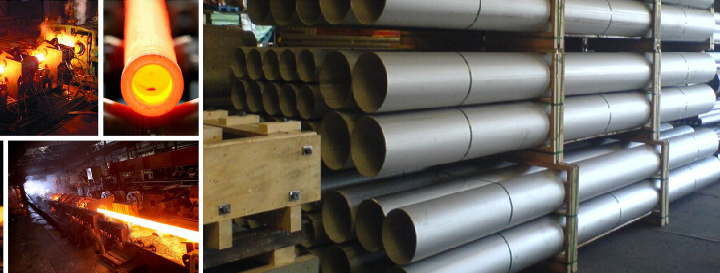
PIPING/TUBING CONFIGURATIONS
I. Pipe / tube fabrication: Seamless Pipe: •Strongest amongst all pipes. •Homogenous structure throughout pipe length. •Available in wide range of size. •Restriction on large size •Used in manufacturing of bends, elbow, tee. * Seamless pipe are manufacture by following methods: * … Continue reading PIPING/TUBING CONFIGURATIONS
 AMARINE